
Walk into any gym in 2026 and count the tubs. The powder in the cupholder, the pastel sachet torn open at the top of the water bottle, the influencer-endorsed stick pack promising "extraordinary hydration" for the low price of a dollar a serving. Hydration has become an industry, and the industry has a message it repeats until it sounds like physics: water alone is not enough.
Here is the part the tubs will not tell you. They are half right, and the fix is older, cheaper, and sitting in the produce drawer. The most efficient slow-release electrolyte delivery system ever designed is not a packet. It is a peach.
This is the case for edible hydration, the practice of getting a real share of your water from food instead of chasing it glass by glass. It is not a trend and it is not a hack. It is the way human beings hydrated for most of our history, and the science that explains why it works is the same science the powder companies quietly rely on.
Why plain water is a leaky bucket
Start with an uncomfortable truth. Plain water is a mediocre way to stay hydrated, and it is mediocre precisely because it is pure. When you drink a large glass of nothing but water, it hits your bloodstream fast and dilutes it. Your blood's osmotic pressure drops. Your kidneys read that drop as a signal that you are carrying too much fluid, and they open the floodgates. A good chunk of what you just drank is on its way back out within the hour. You have felt this. It is the reason a chugged bottle sends you to the bathroom twenty minutes later, still somehow thirsty.
Water is not the enemy here. It is fast, clean, calorie-free, and your body absorbs it beautifully. The problem is retention. What your body actually wants is fluid it can hold onto, and holding onto fluid takes more than water. It takes company.
The study the powder companies don't advertise
In 2016, a team led by Ronald Maughan at Loughborough University set out to rank ordinary drinks by how well the body actually keeps them. They gave healthy people a liter of thirteen different beverages and measured how much came back out over four hours. The result, now known as the beverage hydration index, upended the intuition that water is the gold standard.
The winners were not sports drinks. According to the research published in the American Journal of Clinical Nutrition, full-fat milk, skimmed milk, and an oral rehydration solution all beat water decisively, keeping people roughly fifty percent better hydrated at the two-hour mark. Orange juice edged out water too. Cola, coffee, tea, beer, sparkling water, and the sports drink all landed in a dead heat with plain water or worse.
Why would milk out-hydrate water? Because of everything else in the glass. The small amounts of protein and fat slow how quickly the stomach empties, so the water content trickles into the blood instead of flooding it. The electrolytes hold the fluid in the body's water space. The osmotic pressure never crashes, so the kidneys never panic. The drink is retained instead of flushed. Milk, in other words, wins because it is water plus stuff. And a bowl of fruit is water plus stuff too.
What "eating your water" actually means
Roughly twenty percent of the average person's daily fluid intake already comes from food, and that number is wildly underrated. The reason is that water-rich foods deliver hydration the way milk does in the Maughan study, packaged rather than poured. The fiber slows digestion. The natural potassium, magnesium, and sodium behave like a built-in electrolyte blend. The natural sugars nudge the small intestine to absorb fluid more efficiently. You are not just eating water. You are eating a delivery mechanism engineered by evolution to keep that water in you.
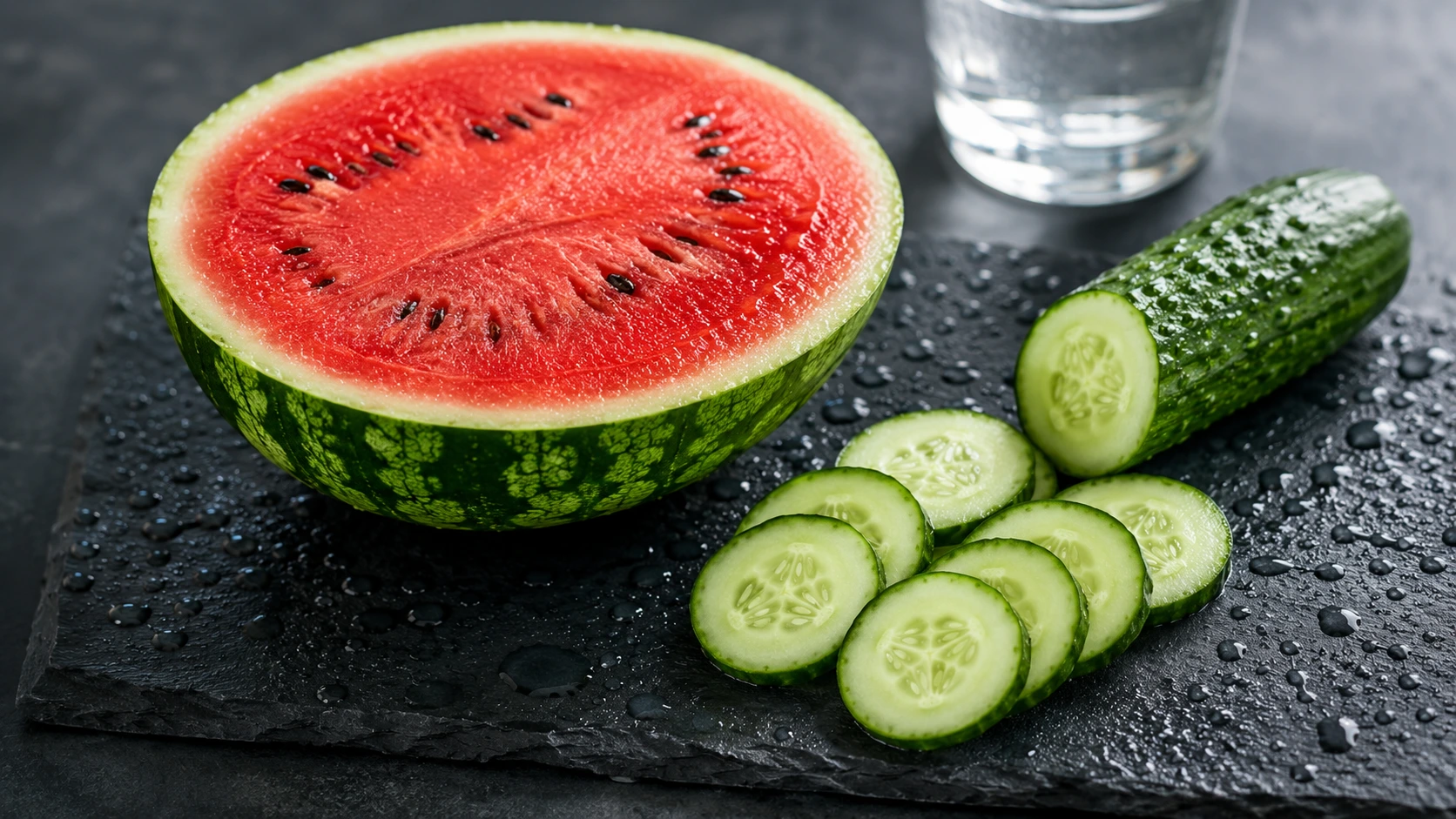
And the raw numbers are startling once you look. Per registered dietitians at the Cleveland Clinic, iceberg lettuce and cucumber run about 96 percent water, celery and zucchini about 95, tomatoes about 94, and cauliflower and watermelon around 92. Strawberries sit near 91, cantaloupe near 90. As Harvard Health notes, a large salad, a wedge of melon, and a smoothie can quietly contribute a couple of cups of fluid before you have touched your water bottle. A single cup of cucumber is nearly half a cup of water on its own.
These are not weak, throwaway calories either. They arrive with the vitamins, antioxidants, and above all the electrolytes that determine whether fluid stays or goes. Watermelon carries potassium, the mineral that governs the body's water balance. Leafy greens carry magnesium. If you want the fastest primer on why one mineral form absorbs better than another, our colleagues at Natural Active Care break it down in their guide to which form of magnesium your body actually uses, and the principle carries straight over to food: the mineral matters as much as the water it travels with.
The honest catch
Now the part a responsible editor has to say out loud, because the powder companies never do about their own product and the wellness blogs never do about produce. Edible hydration is an upgrade, not a miracle. In a well-hydrated person, the difference between eating your water and drinking it is real but modest, and the research is careful to call it slight rather than dramatic. Nobody is claiming a plate of watermelon replaces a day's worth of fluid. You still need to drink.
What food buys you is fluid retention and the electrolytes that come with it, and that edge tilts from nice-to-have toward genuinely useful in exactly the situations H2Goals readers live in. A hard summer training block. A construction shift in the heat. A long flight. Any stretch where you are sweating out minerals faster than a plain bottle can replace them. That is precisely where the packaging around the water starts to earn its keep, and where reaching for produce beats reaching for a glass. If you have ever finished eight glasses a day and still felt drained, we made the full case for why in why you are still tired and thirsty after your gallon jug.
Food versus the packet
None of this means electrolyte products are a scam. When you are genuinely depleted, a properly dosed sodium-and-glucose formula does real work, and we sorted the ones worth buying from the flavored-water impostors in our breakdown of what actually matters for recovery. The clinical literature backs this up: as Northwestern Medicine explains, without adequate electrolytes, water alone may not fully hydrate you.
But notice what that argument concedes. If the value of the packet is its electrolytes, then any source of those electrolytes does the job, and a bowl of fruit brings them with fiber, vitamins, satiety, and zero added sugar instead of a proprietary blend and a receipt. The powder solved a real problem. It simply is not the only thing that solves it, and it is by far the most expensive.
How to actually do it
The move is not to abandon your water bottle. It is to stop treating hydration as a task you perform only with your throat. Front-load a workout with watermelon or oranges instead of a pre-mixed drink and you get water, potassium, and quick-absorbing natural sugar in one bite. Build lunch around a real salad and you bank a cup of fluid you would otherwise have had to remember to drink. Reach for cucumber, celery, berries, or a citrus wedge when the afternoon slump hits, and you rehydrate and refuel at the same time. Even post-workout recovery, the window everyone tries to fill with a shaker bottle, responds to whole food carrying its own water and minerals.
The best part is that none of it requires discipline in the way choking down a fourth bottle does. Food is pleasant. That is the quiet genius of eating your water: it hides a performance strategy inside something you were going to enjoy anyway.
The bottom line
The hydration industry spent the last few years convincing us that water needs to be fixed, and then selling us the fix by the tub. They were not lying about the science. Water really does hold better with electrolytes and a little slowing-down. They were only quiet about the cheapest place to find both. The next time a stick pack promises to rescue your water, remember that the original functional beverage has a rind, a stem, or a peel, and it has been outperforming the packet since long before anyone thought to bottle it.
Drink your water. Then eat some of it too. Your bloodstream will hold the difference.