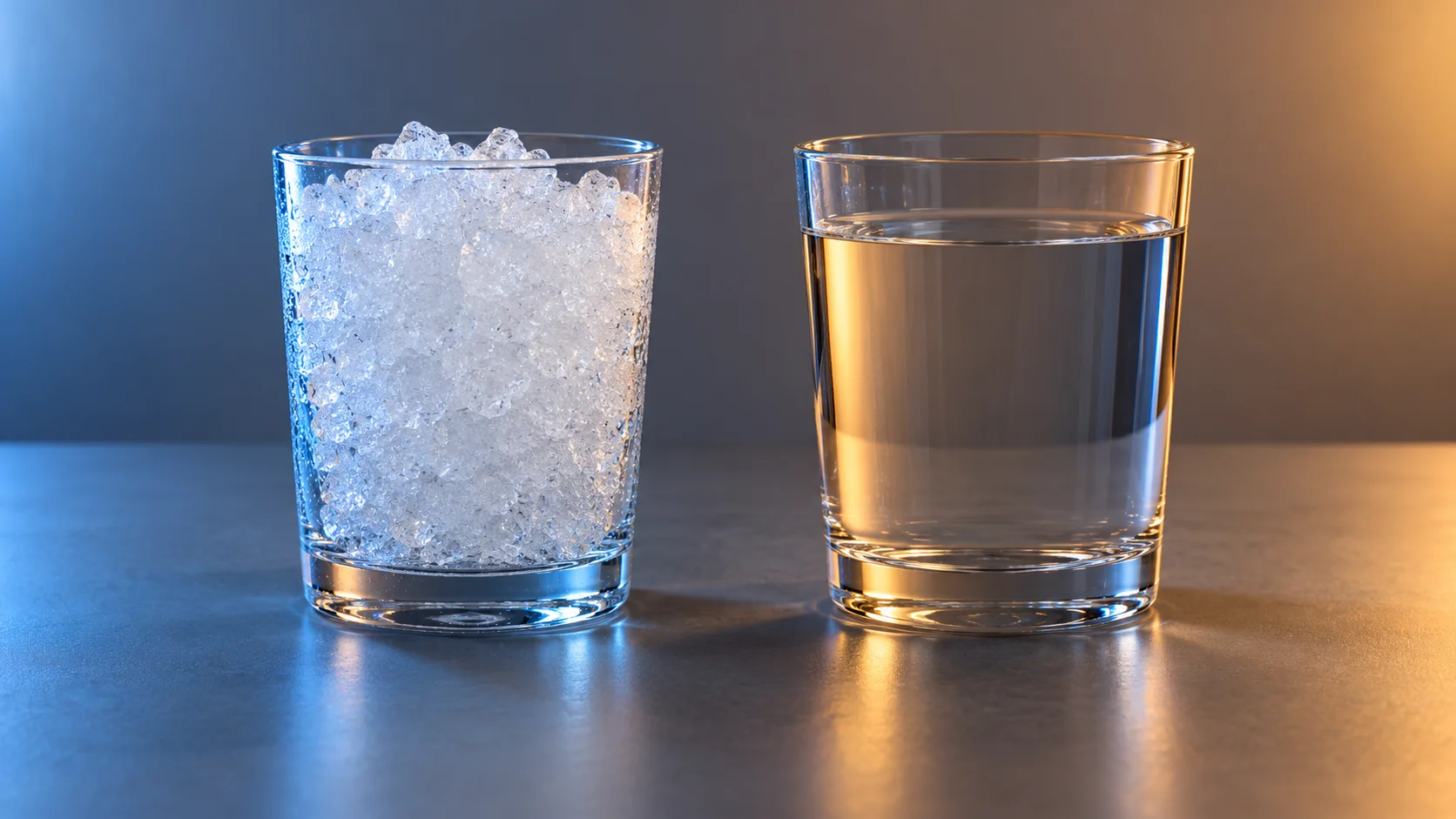
Ten men ran on a treadmill in a room held at 34 degrees Celsius until they could not run any longer, and the only thing that changed between their two attempts was what they drank beforehand. After a slushy drink of crushed ice they lasted a little over 50 minutes on average, and after the same volume of cold water from the fridge they stopped at roughly 41.
That 2010 trial from Edith Cowan University in Western Australia is one of the more vivid results in a body of research that asks a deceptively simple question. Does the temperature of what you drink change how much you drink, how you perform in the heat, and how quickly the fluid does its job?
The direct answer is yes on the first two counts and mostly no on the third. Cool drinks below room temperature reliably increase how much people choose to drink during exercise, ice slurry taken before training in the heat can extend endurance, and the idea that cold water reaches the bloodstream faster than warm water is not well supported. The details, especially the part about drinking ice during exercise, are where most hydration advice goes wrong.
Temperature Changes How Much You Drink
In 2012 a team led by Catriona Burdon at the University of Wollongong pulled together 14 studies of adults exercising with drinks at different temperatures. All 10 studies that measured palatability found that people preferred the cooler option, and a meta-analysis of five studies found that participants drank about 50 percent more of a cool or cold beverage than of a control drink at 22 degrees Celsius or warmer.
The extra volume mattered for hydration. In four studies that tracked body mass, the cooler drinks reduced exercise dehydration by about 1.3 percent of body mass, which is a meaningful margin given how quickly performance begins to slide once fluid losses climb. The Wollongong review concluded that drinks below 22 degrees improve palatability, intake and hydration during exercise.
The temperature that seems to work best is cool rather than icy. A 2023 review by Lindsay Baker for the Gatorade Sports Science Institute, an industry-funded research arm, put it plainly: "palatability and fluid intake seem to be maximized when beverage temperature is cool (15°C)." That lines up with a much older recommendation from the American College of Sports Medicine, whose 1990s fluid position stand read: "It is recommended that ingested fluids be cooler than ambient temperature," with a target range of 15 to 22 degrees.
What That Means in a Bottle
Fifteen degrees Celsius is about 59 degrees Fahrenheit, which is roughly what tap water feels like in many places during spring or what a fridge-cold bottle warms to after 20 minutes in a bag. Water that has sat in a car through a July afternoon can easily pass 30 degrees, and the research suggests most people will simply drink less of it without noticing.
For people who struggle to drink enough on an ordinary day, temperature is one of the cheapest levers available. The dread of warm, flat water is familiar to anyone who struggles to drink enough, and the Wollongong data put a number on it.
Ice Slurry Before the Heat
Rodney Siegel and colleagues at Edith Cowan gave their runners 7.5 grams of drink per kilogram of body weight, which works out to a little over half a liter for a 75-kilogram athlete, before the run. The slurry was at minus 1 degree and the cold water at 4 degrees, and the runners exercised at 34 degrees with humidity around 55 percent.
Time to exhaustion rose from 40.7 minutes with cold water to 50.2 minutes with slurry, an improvement of about 19 percent. Rectal temperature before the run fell by 0.66 degrees after slurry against 0.25 degrees after cold water, and the runners on slurry also tolerated a higher core temperature at the point they quit, 39.36 against 39.05 degrees. The authors described slurry as "an effective and practical precooling maneuver for athletes competing in hot environments."
The Meta-Analysis Is More Cautious
Single trials tend to look better than the field as a whole. A 2018 meta-analysis by Choo and colleagues in the European Journal of Sport Science pooled 22 crossover studies of precooling before exercise in heat above 26 degrees and found that ice ingestion produced a small benefit whose confidence interval crossed zero, while cold-water immersion delivered a clearer improvement.
The same analysis found that core temperature rose faster during exercise after ice ingestion, which suggests some of the head start is spent quickly once work begins. For a race morning, slurry remains a reasonable tool to test in training, though a cold bath or soaked towels may be the stronger option where they are practical.
The Problem With Ice During Exercise
Here the advice most athletes hear runs into physiology. The stomach and abdomen carry thermoreceptors that sense cold fluid, and when they fire, the body responds as if it needs to shed less heat, turning down sweating even when core and skin temperature have not changed.
In 2016 Nathan Morris, Geoff Coombs and Ollie Jay had cyclists ride for 75 minutes at 33.5 degrees in dry air, about 24 percent humidity, drinking either ice slurry or fluid at body temperature. With slurry, whole-body sweat loss was 191 grams lower and evaporative heat loss fell by 381 kilojoules, more than cancelling the 200 kilojoules the ice absorbed as it warmed. Net heat loss ended up 131 kilojoules lower, and the study concluded that "recommendations for ICE ingestion during exercise in warm, dry conditions should be reconsidered."
Humidity Decides the Outcome
In a 2018 review for the same Gatorade-funded institute, Jay and Morris explained that when humidity is high and air is still, sweat drips off rather than evaporating, so suppressing it costs little, and in those conditions "a net cooling effect from cold water and ice slurry ingestion during exercise should develop."
That makes the reading on a weather app less useful than the reading on a wet bulb globe thermometer, which weighs humidity and radiant heat together. Our earlier breakdown of why WBGT beats the heat index for training decisions applies directly here: in dry desert heat, ice in the bottle during a run may work against you, while on a humid East Coast August morning it can help.
Cold Water Does Not Empty Faster
A persistent claim holds that cold water leaves the stomach faster and therefore hydrates sooner. The evidence that exists points the other way or shows no lasting difference.
A small study in the journal Gut gave six volunteers drinks at 4, 37 and 50 degrees and found the cold drink's initial emptying "significantly slower than the control drink," with stomach temperature dropping to 21 degrees and recovering within 20 to 30 minutes. A follow-up from the same group reported that "both cold and warm drinks stimulate a pattern of motility associated with retardation of transpyloric flow," with the strongest effect at 4 degrees.
A 2009 Brazilian review in Revista de Nutrição read the literature as showing at most a brief early difference with no change in total emptying time, and concluded that drinking enough matters more than the temperature of what is drunk. The advantage of cool fluid, in other words, is behavioral: people drink more of it.
Putting It Together for Training Days
For everyday training, a bottle kept cool, near 15 degrees, is the evidence-backed default because it encourages larger, more frequent sips. Insulated bottles and a few ice cubes at the start of a session usually land in that range by the halfway point, which is close to ideal.
Before a hot race or a long session in heat, ice slurry is worth rehearsing on a training day, given the Edith Cowan result and the more modest pooled evidence, while remembering that it can upset some stomachs. During exercise in dry heat, cool water is the safer choice than ice, and in humid heat the colder option becomes more defensible.
The gut receptors in the Morris study have a cousin in another piece of hydration research. Our look at why pickle juice stops cramps through a reflex rather than electrolytes traced a similar shortcut between the mouth, the gut and the nervous system, and both findings point to how much of hydration happens before any fluid is absorbed.
The runners in Western Australia drank the same volume on both days. What changed was temperature and timing, and it bought them more than nine minutes on the treadmill.