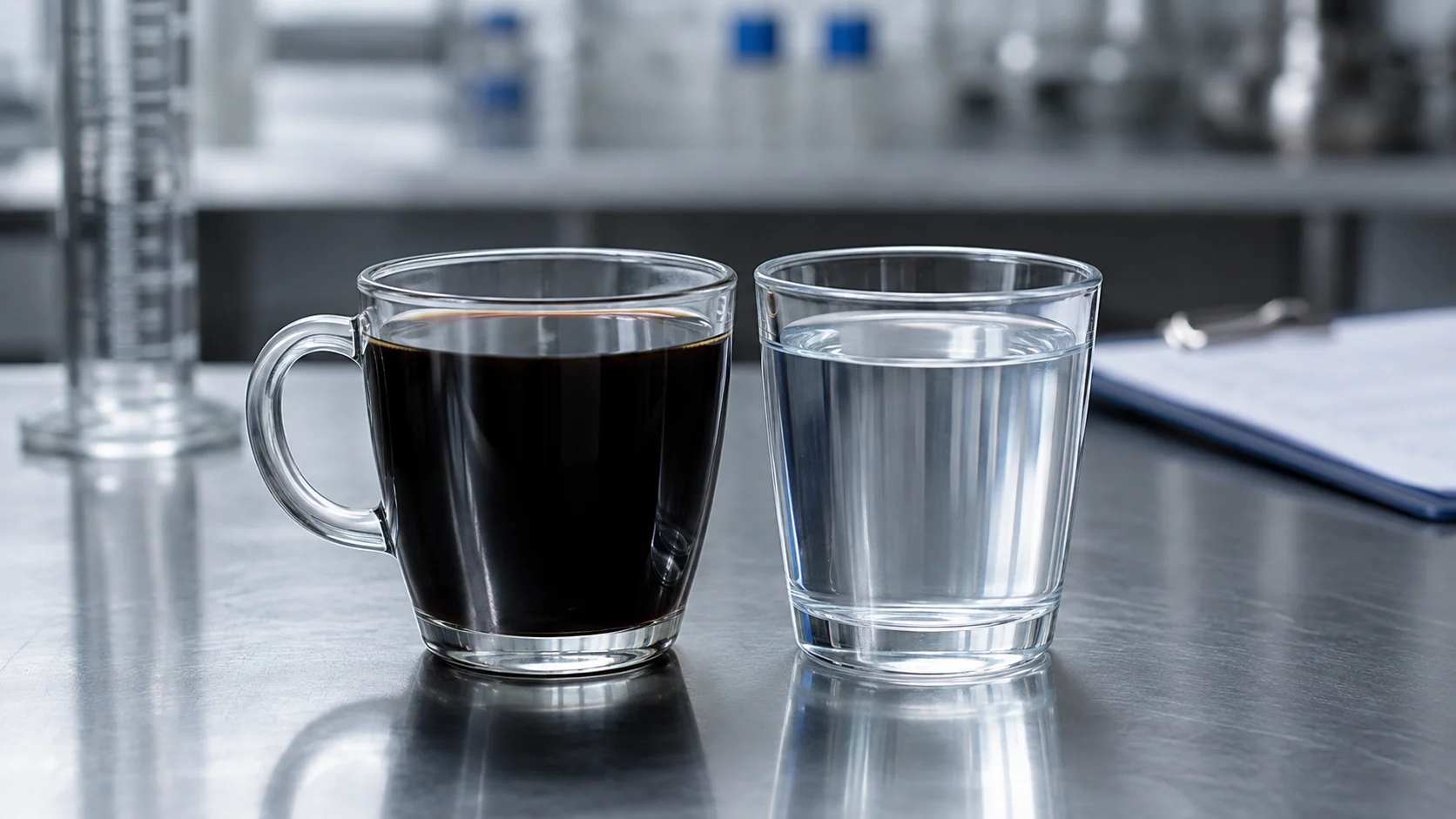
Fifty men who drank between three and six cups of coffee a day agreed to spend three days drinking nothing but coffee, then, after a ten-day washout, three more days drinking nothing but water. Researchers at the University of Birmingham measured their total body water with deuterium dilution, collected every drop of urine over twenty-four hours, and ran blood work on both arms of the trial. Total body water came in at 51.5 kilograms on coffee and 51.4 on water. Urine volume came in at 2,409 millilitres against 2,428.
The study, published in PLOS ONE in January 2014, ended with a sentence that most public health copy has still not caught up to: coffee, consumed in moderation by people used to it, "contributes to daily fluid requirement and does not pose a detrimental effect to fluid balance".
So the answer to the question that sends people to the water cooler feeling guilty about their second cup is yes, coffee counts. Caffeine is a mild diuretic in the pharmacological sense, but at the doses habitual drinkers actually consume, the fluid arriving in the cup more than covers the extra fluid leaving. The exceptions are specific and worth knowing: a large single dose in someone who has been off caffeine for weeks, and a hard training session in the heat, where the picture gets more interesting than either camp usually admits.
What the coffee trial actually controlled for
Fifty healthy male habitual coffee drinkers received four 200 millilitre cups a day delivering 4 milligrams of caffeine per kilogram of body weight, which for the average participant landed near 300 milligrams daily, against four cups of water on the alternate arm. Diet and activity were controlled, plasma caffeine was measured as a compliance check, and the outcome set went well past body weight to serum osmolality, urine osmolality, specific gravity, sodium, potassium and creatinine.
Nothing separated the two conditions. No difference in total body water, no difference in twenty-four hour urine volume, no difference across any haematological marker, and no change in body mass. For a habitual drinker at a moderate dose, the beverage behaved like the beverage it replaced.
Two limits on that finding deserve to travel with it. Every participant was male, and every participant was already habituated. The study says what it says about men who drink coffee daily, and it does not extend itself to someone who has not touched caffeine since March and drinks a triple espresso before a long run.
The dose where the diuretic effect shows up
Caffeine's reputation was earned in a different set of experiments. Ronald Maughan and Jane Griffin reviewed that literature in the Journal of Human Nutrition and Dietetics in 2003 and put a number on it, reporting that acute ingestion of at least 250 to 300 milligrams stimulates urine output in people who have been deprived of caffeine for days or weeks. Their sharper line reads that a diuretic response is likely at an acute dose of about 300 milligrams or more and unlikely at doses of about 250 milligrams or less.
The second half of their review is the part that gets dropped in retellings. Tolerance to the diuretic effect develops, and the authors describe it as profound, which is why the studies that best resemble ordinary life find nothing. Their conclusion is unusually direct for a review paper: the most ecologically valid published work "offers no support for the suggestion that consumption of caffeine-containing beverages as part of a normal lifestyle leads to fluid loss in excess of the volume ingested".
Lawrence Armstrong's group at Connecticut tested the chronic version in 2005, equilibrating healthy men at 3 milligrams per kilogram daily for six days and then splitting them into placebo, 3 milligram and 6 milligram groups for five more days with no other dietary caffeine. Body mass, urine osmolality, specific gravity, colour, twenty-four hour volume, sodium and potassium excretion, serum sodium and osmolality all held steady. The authors wrote that none of the groups showed evidence of hypohydration, and that the findings challenge the widely accepted notion that caffeine acts chronically as a diuretic.
The people who write the fluid guidelines already settled this
The 2004 Institute of Medicine report that set the reference intakes for water addressed caffeinated beverages explicitly, and the sentence has been sitting in the summary chapter for more than twenty years. While such beverages have shown diuretic effects in some studies, the report says, the available information indicates that the effect "may be transient in nature, and that such beverages contribute to total water intake".
That report set the adequate intake for total water at 3.7 litres a day for men and 2.7 litres for women aged nineteen to thirty, and the word total is doing real work there, because it includes water, every other beverage and the water in food. The National Academies put roughly 80 percent of daily water intake in beverages, caffeinated ones included, and the remaining 20 percent in food. Mayo Clinic reaches the same place in plainer language, noting that most research suggests the fluid in caffeinated drinks balances the diuretic effect of typical caffeine levels, and that high doses taken all at once are more likely to increase urine output in someone not used to caffeine.
"Caffeine really had absolutely no influence on hydration status."
That is Douglas Casa of the University of Connecticut, one of the field's most cited heat and hydration researchers, reviewing the Birmingham trial for NPR in January 2014. In the same piece, lead author Sophie Killer framed the mechanism the way a coach should: "It's well understood that if you drink coffee habitually you can develop a tolerance to the potential diuretic effects of coffee."
Training in the heat is the real exception, and it cuts both ways
Take the same caffeine dose into a hot room with a workload attached and the numbers stop being quite so tidy. Del Coso and colleagues put seven heat-acclimated cyclists through two hours at 63 percent of maximal oxygen uptake in 36 degree heat after 6 milligrams per kilogram of caffeine, and measured a 28 percent rise in urine flow and roughly 14 percent higher sweat losses of sodium, chloride and potassium. Their conclusion is the sentence to hold onto, because those effects were judged not enough to affect dehydration or blood electrolyte levels across two hours of exercise in the heat.
Performance held up too. A 2022 systematic review in Sports Medicine pooled six studies of trained individuals taking roughly 6 milligrams per kilogram an hour before exercise at 34 degrees and found a non-significant 2.1 percent improvement in endurance performance alongside a small increase in the rate of core temperature change, 0.10 degrees per hour. Ganio's group had earlier compared cycling at 12 degrees and 33 degrees and reported that caffeine improved performance independent of environmental temperature, with rectal temperature no different between caffeine and placebo.
A 2024 study in the European Journal of Applied Physiology gave twelve caffeine-habituated men 5 milligrams per kilogram an hour before cycling to exhaustion at 35 degrees and 40 percent humidity, and found no performance benefit, a 21 percent higher sweat rate, 7.9 percent more heat production and thermal comfort ratings 18.3 percent worse. The dose did not help and the athletes felt hotter.
Read across all four and a working position emerges. Caffeine before a hot session is not a hydration problem, since the fluid losses it adds are small and the sports drink or water you take with it covers them. It is a thermal comfort question and an individual one, and the athlete who finishes a summer session feeling cooked on caffeine is not imagining it. The sodium side of that equation is a separate conversation, and the research this month has been less kind to the electrolyte pitch than the marketing would suggest.
The numbers to plan around
FDA cites 400 milligrams a day for most adults, about two to three 12 ounce cups of coffee, as an amount not generally associated with negative effects, and estimates toxic effects such as seizures with rapid consumption of around 1,200 milligrams. The European Food Safety Authority's 2015 opinion adds the single-dose figure that matters for training, concluding in EFSA Journal 2015;13(5):4102 that single doses up to 200 milligrams do not give rise to safety concerns, including when consumed less than two hours before intense physical exercise under normal environmental conditions, with 400 milligrams a day for non-pregnant adults and 200 milligrams a day during pregnancy.
Knowing what you are actually drinking is harder than it should be. FDA puts regular brewed coffee between 113 and 247 milligrams per 12 ounces, a range wide enough that two identical-looking cups can differ by more than a shot of espresso. Mayo Clinic lists 96 milligrams for 8 ounces of brewed coffee, 63 for a single espresso shot and 200 for a 2 ounce energy shot, while FDA puts energy drinks between 54 and 328 milligrams per 16 ounces. The morning cup is rarely the problem. The pre-workout scoop stacked on top of it is where people cross 300 milligrams in a single hit without noticing.
Coffee counts toward your daily fluid intake, and the practical adjustment for most athletes is smaller than the myth implies. Keep the habit, count the cups toward the total, and treat the pre-session dose as a stimulant decision rather than a hydration one. Reserve the caution for the two cases the evidence actually supports, the return-from-a-caffeine-break athlete taking a large dose, and the hot session where a familiar dose leaves you sweating harder and feeling worse. The rest of the time, the mug on the desk is doing more for you than the guilt is. If the goal is putting fluid where it needs to go rather than counting ounces, the timing question is the one worth spending attention on.