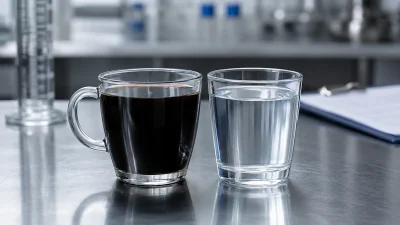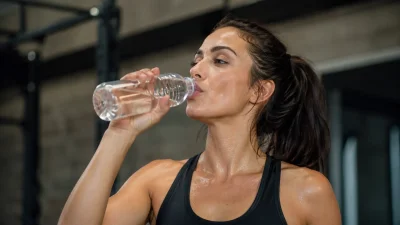
Ten men walked into a laboratory at the University of Alabama and lifted the same full body program twice. The sessions were matched for exercises, sets and load, and the men were matched against themselves, which removes most of the excuses a training study usually has to apologize for. The only variable that moved was body water.
In the properly hydrated condition the group completed 169.4 repetitions across all sets combined. Carrying roughly three percent less body mass in fluid, the same ten men managed 144.1. That is twenty five repetitions of unearned volume loss, taken out of a session nobody would have described as compromised while it was happening.
The finding, published by Kraft, Green, Bishop and colleagues in the European Journal of Applied Physiology, points at something lifters rarely audit. Dehydration and strength performance are linked closely enough that a training week can lose meaningful work without a single missed session, and the loss hides inside sets that still get completed.
The Number a Meta-Analysis Put on It
Individual studies drift. Twenty eight of them pooled together drift less, which is what Sebastien Savoie, Robert Kenefick, Brett Ely, Samuel Cheuvront and Eric Goulet assembled for Sports Medicine in 2015. Their pooled estimates gave the deficit a size rather than a vibe.
Muscle endurance fell 8.3 percent under hypohydration, with the upper body at 8.4 percent and the lower body at 8.2 percent, close enough that the effect looks systemic rather than local. Muscle strength dropped 5.5 percent and anaerobic power 5.8 percent. The authors concluded that hypohydration, "or factors associated with dehydration, are likely to be associated with practically important decrements in muscle endurance, strength, and anaerobic power and capacity."
Translate 5.5 percent into plate math and it stops being abstract. A lifter whose working top set is 315 pounds is functioning at roughly 298 on a day when body water sits low, and the set that was programmed for five will feel like the set that was programmed for six. Nothing about the training log records that adjustment, because the log records what was lifted rather than what was available.
What Dehydration Leaves Alone
The same meta-analysis found a boundary, and the boundary is the reason the topic deserves precision instead of alarm. Vertical jumping ability came through at 0.9 percent, a difference the authors did not treat as significant, and anaerobic capacity at 3.5 percent likewise failed to clear the bar.
A 2025 study in Nutrients found the same shape in a different sport. Giannis Arnaoutis and Petros Neophytou brought fourteen elite male karate athletes to two percent body mass reduction through twenty four hours of fluid restriction, then ran isokinetic knee testing at three speeds. Mean power in knee extension and flexion fell significantly at 60 degrees per second, the slowest setting, while the differences at 180 and 300 degrees per second did not reach significance.
Slow, sustained, effortful work suffers. Brief explosive work mostly does not. A powerlifter grinding a five second single and a hypertrophy trainee pushing a set of twelve to failure are both operating in the zone where fluid loss shows up, while a sprinter leaving the blocks is largely outside it.
The Scale Is the Only Instrument That Reads This
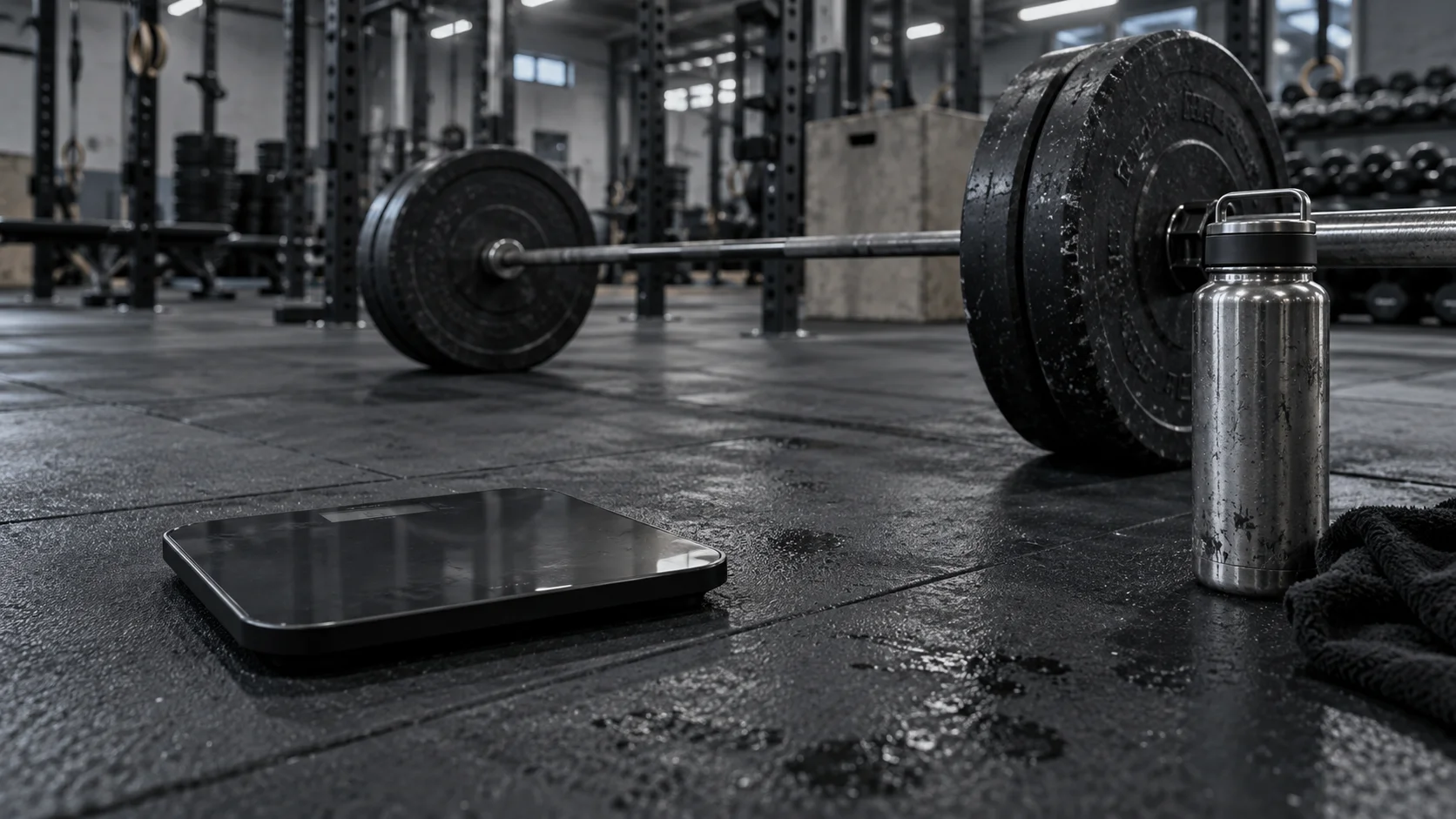
Thirst is a lagging indicator, urine color is confounded by everything from riboflavin to breakfast, and a wearable estimating hydration is estimating. The National Athletic Trainers' Association position statement written by Douglas Casa and colleagues put the practical measurement plainly, stating that "body weight changes during exercise give the best indication of hydration status" and directing that weight be checked before, during and after sessions to estimate fluid balance.
The association's threshold is where the training implication lives. Dehydration of one to two percent of body weight, the statement says, "begins to compromise physiologic function and negatively influence performance," and losses of three percent or more compound the problem. For a 180 pound lifter, two percent is 3.6 pounds, which is a volume of sweat an eighty minute session in a warm gym can produce without any drama at all.
Running the Weigh In
Step on the scale in minimal clothing before training, step on it again after, and subtract, counting anything you drank during the session as fluid you have already replaced. A loss of more than two percent means the session finished on the wrong side of the line, and the number tells you how much more to drink during the next one rather than after it.
Because sweat rate varies by an enormous margin between two people doing identical work, the figure is only useful as your own figure, which is the argument for measuring your own sweat rate instead of borrowing an average. Repeat the weigh in across four sessions covering a warm day, a cold day, a heavy day and a conditioning day, and the pattern that emerges is a hydration plan rather than a guess.
Why the Weight Room Hides This Better Than the Track
Endurance athletes catch fluid loss because their sport is timed. A runner who fades in the last two miles sees the split, and the evidence arrives whether or not the runner wants it. A lifter working in the five to twelve repetition range has no equivalent instrument, since the last repetition of a hard set feels like the last repetition of a hard set regardless of how much was left in reserve.
Air conditioning compounds the concealment by evaporating sweat before it registers as sweat. So does a training schedule that lands in the evening after a workday of coffee and no water, and so does the common lifting habit of arriving fasted, which removes the food that ordinarily supplies a fifth or more of daily fluid intake. The result is a population that rarely feels dehydrated and frequently is, working in exactly the intensity range the research says fluid loss touches.
Replacing what is lost does not require the aisle of sports drinks the problem tends to get sold with. Water handles the majority of a gym session, and the case for adding sodium strengthens as duration, heat and sweat rate climb, which is a distinction the research on sodium versus plain water sets out in more detail.
What to Change Next Week
Start the session already topped up rather than chasing the deficit through it, since fluid absorbed during training arrives too late for the sets in front of it. Drink through the session at a pace that keeps the post workout weigh in inside two percent, and use the Casa recommendation for what comes after, which calls for twenty five to fifty percent more fluid than the measured loss to account for what the kidneys will pass in the following hours.
Then check the log against the scale for a month. Sessions on the wrong side of two percent will cluster with the sessions where the last set came apart, and the cluster is the argument. Five and a half percent of a top set is not a training variable most people can afford to leave unmeasured, and unlike sleep, stress or genetics, it costs a scale and forty seconds to fix.