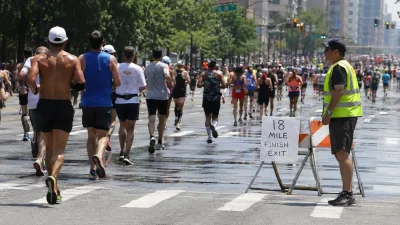

Eight volunteers, five men and three women, were dehydrated in the laboratory until they had lost an average of 2.1 percent of their body mass and lost about 5 percent of their plasma volume. Then Ron Maughan, John Leiper and Susan Shirreffs split the recovery. On one trial the volunteers replaced the loss with a sports drink alone, and on another they ate a standard meal and drank alongside it.
Urine output was lower after the meal, and a larger fraction of everything the volunteers took in stayed in their bodies, according to the 1996 study in the European Journal of Applied Physiology. The authors attributed much of the difference to the larger amounts of sodium and potassium the meal contained.
The practical answer from that experiment, and from the research that followed it, is that rehydrating with food is often better than rehydrating with a drink alone, because the minerals on a plate help the body hold on to the water that goes down with them. A post-training meal, eaten with ordinary fluid, belongs in a recovery plan rather than being treated as a reward for after the hydration is done.
Why the Plate Holds Water
Drinking after exercise is only half the problem, since the kidneys decide how much of that fluid stays. When a large volume of plain, low-sodium fluid arrives quickly, blood sodium dips, the body responds by producing more urine, and much of the drink leaves within a few hours. Sodium and, to a lesser extent, potassium slow that response by keeping the fluid in the spaces where the body needs it.
Maughan and Leiper had measured the sodium effect directly a year earlier. In a 1995 study in the same journal, volunteers drank roughly 2,045 milliliters of one of four drinks containing 2, 26, 52 or 100 millimoles of sodium per liter. Urine volume was inversely related to the sodium content, and only the two saltiest drinks left subjects approximately euhydrated by the end of the recovery period.
Those higher concentrations are saltier than many people would choose to drink, which is where a meal earns its place. A plate of ordinary food delivers sodium and potassium without forcing anyone to swallow a brine, and the 1996 trial showed the result in the measure that counts, which is fluid retained rather than fluid consumed. Readers comparing the sodium in commercial drink mixes will notice how far apart those products sit, and food can close part of that gap.
When the Drink Stops Mattering
A 2017 trial in Physiology and Behavior tested the idea under freer conditions. Ten endurance-trained men completed hard sessions and then recovered with water on two occasions, Powerade on another and Sustagen Sport, a milk-based supplement, on a fourth, while snack foods were available throughout. Total urine output did not differ between the trials. The authors concluded that "fluid restoration following exercise is tightly regulated" when people eat, regardless of which drink they reach for.
That finding complicates a common marketing claim. Sports drinks and electrolyte mixes earn their keep in the situation in which no food is available, such as the middle of a long race or a double session with no break for a meal. When an athlete sits down to eat within the recovery window, the drink choice appears to shrink in importance, and plain water performs as well as products sold at a premium.
The Beverage Hydration Index, published by Maughan and seven colleagues in the American Journal of Clinical Nutrition in 2016, points the same direction from a different angle. The researchers gave 72 healthy, fasted men one liter each of 13 different drinks while at rest and measured what remained after two hours. Against water as the 1.0 reference, oral rehydration solution scored 1.54, full-fat milk 1.50 and skimmed milk 1.58. Stuart Galloway of the University of Stirling, one of the authors, explained the purpose: "We set out to establish how various fluids affect people's hydration levels on a daily basis." Our earlier guide to eating your water covered how that index applies to water-rich produce, and the same mineral logic helps explain why milk and a full meal both outperform water consumed alone.
How Much Water Already Comes From Food
Most people underestimate how much of their daily water arrives on a fork. The Institute of Medicine's dietary reference report for water, published in 2004, set an adequate intake of total water at 3.7 liters a day for young men and 2.7 liters for young women, and estimated that food supplies approximately 19 to 20 percent of total water intake in the American diet. The European Food Safety Authority's 2010 opinion set lower adequate intakes of 2.5 liters for men and 2.0 liters for women and estimated that food provides 20 to 30 percent.
That share depends heavily on what a population eats. A 2016 review of population surveys in the British Journal of Nutrition reported food water contributions of 19 percent in the United States, 33 percent in the Republic of Ireland and 40 percent in China. In Japan, a 2015 study in the European Journal of Clinical Nutrition by Tani and colleagues found that adults took in a mean of 2,230 grams of water a day, and 51 percent of it came from foods. Water from food fell by 3.1 grams a day for every one-degree rise in temperature.
The water content of foods explains how a diet built on soups, rice, vegetables and fish reaches half. USDA nutrient data lists raw cucumber with peel at 95.2 grams of water per 100 grams, raw watermelon at 91.5, plain whole-milk yogurt at 87.9 and oatmeal cooked in water at 83.6. A bowl of oatmeal and a cup of yogurt can carry more water than many people drink before lunch. Add a salted grain or a broth and the meal supplies the sodium the 1995 study identified as the key to retention.
Building a Recovery Meal That Hydrates
The research supports a simple sequence for anyone who trains hard enough to lose meaningful weight in sweat. Weighing before and after a session gives a rough measure of the deficit, and a normal meal eaten with fluid in the hours afterward will retain more of that fluid than the same volume of drink taken alone. Salted foods are an asset in that window rather than a problem, especially for heavy sweaters and for people training in heat.
The National Athletic Trainers' Association made sodium part of its 2017 position statement on fluid replacement, stating that "the athlete's diet and rehydration beverages should include sufficient sodium" to cover losses without excess. Brendon McDermott, speaking in the association's release on the statement, framed it around individual needs: "We've reinforced the importance of individualized hydration plans."
The cases where drinks still matter most are the ones without a table. During competition, between closely spaced sessions, or when appetite disappears after a hard effort, a sodium-containing drink or milk does the job a meal cannot. People who lean on pickle juice for cramps should note that our look at why pickle juice works on cramps found the effect is a reflex rather than rehydration.
For the rest of the week, recovery hydration looks a lot like dinner. In the 1996 trial, the volunteers who ate kept more of what they drank, the sodium and potassium on the plate accounted for most of the difference, and the drink they swallowed with it was an ordinary one.