
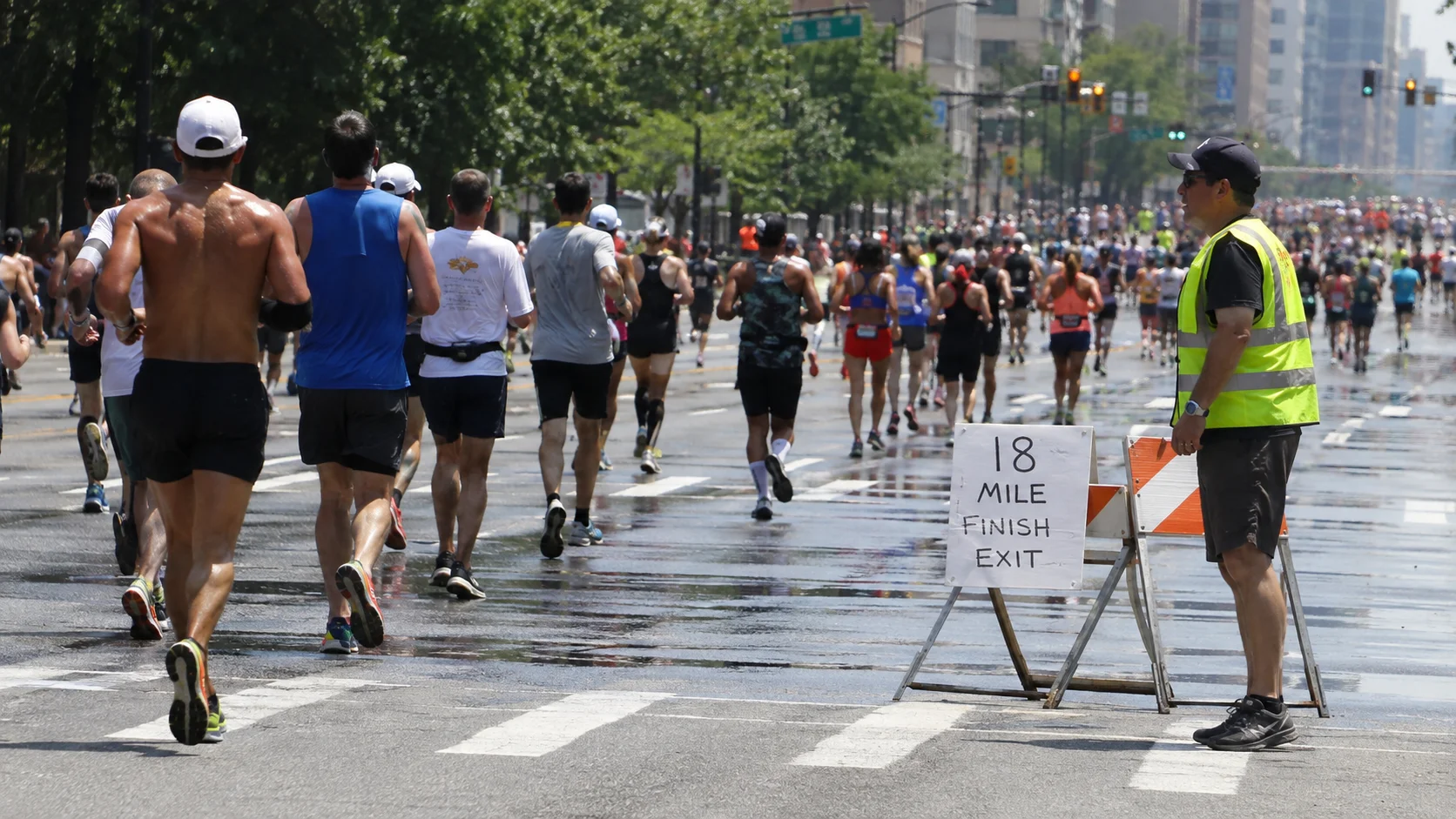
The Los Angeles Marathon put an unusual offer on the table in March. Run the whole thing, or peel off at eighteen miles and take the medal anyway. Of roughly 27,000 runners, fewer than five percent took the exit. Fourteen ended up in the hospital.
That gap, between the escape hatch offered and the escape hatch used, is the entire problem with racing in heat. People train for months. They book flights. They do not stop because a race director suggests it, and they do not ease off because the air feels thick at mile six. Which means heat has to be handled somewhere other than the course, and the only place left is the weeks before the gun.
In Short: Heat is not just a comfort problem, it is a time problem, and the clock starts running against you earlier than most people assume. The optimal temperature for marathon running sits around 50 degrees Fahrenheit, and performance begins sliding once conditions push past 60. You cannot negotiate with that on race morning. What you can do is show up with a race day hydration plan built from your own numbers rather than a stranger's, with sodium accounted for, and with two weeks of deliberate heat exposure already in your legs.
The race calendar is moving because the weather already did
American road racing is quietly rescheduling itself. The Twin Cities Marathon, canceled outright in 2023 and started in roughly 70 degree air in 2025, is shifting off the first Sunday in October to later in the month beginning in 2027. The Sioux Falls Marathon, canceled in 2024, moved out of August and into September. The Air Force Marathon, the Little Rock Marathon and the Long Beach Marathon have all pulled their start times earlier. The Associated Press catalogued the shift on August 13, in a week when the contiguous United States was coming off its warmest July on record.
Ed Whetham, who directs the Twin Cities race, put the trade in the plainest possible terms.
"We'll take a 39-degree start over a 70-degree start."
The underlying data comes from a Climate Central analysis called Running Out of Cool Days, which looked at 221 races and found that 190 of them, about 86 percent, face declining odds of optimal conditions by 2045. Every one of the seven Abbott World Marathon Majors trends the wrong way, with Tokyo projected to lose the most ground, roughly twelve percentage points. That report is not new, it came out in October 2025. What is new is that race directors have stopped treating it as a forecast and started treating it as a scheduling constraint. Read the analysis and the pattern is less about any single hot morning than about the shrinking number of mornings that were ever going to be good.
What heat is actually doing to your race
The mechanism is a competition for blood. Working muscle wants it. Skin wants it too, because pushing blood to the surface is how the body sheds heat. Chris Minson, a physiologist at the University of Oregon, describes the result as a system forced to split a limited supply between moving you forward and keeping you from cooking. Cardiac output goes up to cover both jobs, heart rate drifts at a pace that felt easy in April, and the effort you trained to hold at 7:40 per mile starts costing what 7:20 used to cost.
None of that shows up as a dramatic moment. It shows up as a mile 19 where the math quietly stops working. And it is why marathon heat performance is better understood as a pacing and preparation question than as a toughness question. The runners who blow up in the heat are rarely the ones who were unwilling to suffer.
Build the plan around your own body
Test what you actually lose
Sweat rates vary enormously between two people running the same pace in the same weather, which is why generic fluid advice fails so many runners. Sweat rate testing is unglamorous and takes one workout: weigh yourself naked before a run, weigh yourself again after toweling off, track what you drank, and do the arithmetic. A pound lost is roughly sixteen ounces of fluid you did not replace. Do it once in cool weather and once in the worst heat you can find, because the two numbers will not be close. We walked through the full protocol in our guide to building a hydration plan around your own sweat, and the summer version of that test is the one that matters for a fall marathon.
Sodium is the part most people underdo
Gatorade's sports science institute presented data in July on more than 500 women across basketball, soccer, ice hockey and other sports. Forty three percent arrived at training already dehydrated. Fifty seven percent under fueled on carbohydrate during exercise, and half took in none at all. Most striking for anyone racing long: participants replaced only about 20 percent of the sodium they lost, against a target closer to 50 percent. The lead researcher, Dr. Kimberly Stein, framed the finding without much cushion.
"These aren't small gaps between what women's bodies need and how they're fueling."
Two caveats belong with that. The work was presented at a conference rather than published in a peer reviewed journal, and the sponsor sells sports drinks. The direction of the finding still matches what coaches see on hot start lines, and it lands hardest on women, who remain badly underrepresented in sports science, roughly six percent of research focuses on them exclusively. Practical version: if your sodium replacement strategy is whatever the aid station happens to be pouring, you do not have one.
Two weeks, not race week
Heat acclimation is one of the few interventions in endurance sport that reliably works and costs nothing. Ten to fourteen days of repeated exposure, easy efforts in the heat rather than hard ones, expands plasma volume, starts sweating earlier and dilutes the sodium in your sweat. The adaptations are real and they fade, which is the argument against cramming them into the final taper week when you should be resting. If your goal race is in early October, the work belongs in late August and September, not the Thursday before.
The finish line is not the end of the job
One recent finding deserves a place in your gear bag. A randomized trial published in Nutrients in June had fifteen adults exercise to mild dehydration and then drink freely from one of four options: plain water, plain carbonated water, water with electrolytes, and carbonated water with electrolytes. Plain water won on volume consumed. Plain sparkling water produced significantly worse fluid recovery, because carbonation cut how much people voluntarily drank. Adding electrolytes to the carbonated version largely closed the gap.
Fifteen people is a small study, and it was funded by a beverage company with employees among the coauthors, both of which are worth saying out loud. But the practical read is cheap to act on. If the cold thing waiting for you in the cooler is fizzy, it is doing less for your post workout rehydration than the flat bottle next to it, unless it carries electrolytes. Reach for an electrolyte drink or plain water, and save the sparkling for later in the day when you are not chasing a fluid deficit.
When the forecast is bad
Two habits separate runners who salvage hot races from runners who get salvaged by medical tents. The first is checking the right number. Air temperature and heat index both understate radiant load on an exposed road, which is why wet bulb globe temperature has become the standard in high school and collegiate sport, a shift we covered when Texas stopped pretending the shade reading was good enough. Most race weather services publish it. Learn what your personal ceiling is.
The second is deciding your adjusted goal before you are standing in the corral with adrenaline arguing against you. Pick the pace you will run if the reading is above your line, and pick it while you are still capable of arithmetic. Runners who set that number in advance tend to finish. Runners who plan to feel it out at mile ten tend to find out something else.
The calendar shift is going to keep going. More races will move, more will add earlier starts, a few will keep offering short course options that almost nobody takes. None of that changes what happens between your skin and your working muscles on a warm morning. Endurance training in summer is not a lesser version of the real thing, it is the part of the year where the fall race is actually decided. The runners who treat August as preparation for October weather, rather than an obstacle to it, are the ones who get to run the race they trained for.