Does beer dehydrate you? Alcohol can increase urine production by suppressing vasopressin, the hormone that tells the kidneys to retain water. That mechanism helps explain why people often feel dehydrated after drinking, but controlled studies suggest the effect depends on the drink, the dose and a person's starting hydration level.
When researchers match alcoholic drinks for the amount of alcohol they contain and measure urine carefully, moderate beer consumption has little measurable effect on total urine output. Wine and spirits produce a modest, short-term increase that generally disappears within 24 hours. That finding does not make alcohol a good hydration strategy, and it should not be extended to heavy drinking: the relevant trials tested roughly two standard drinks or one liter of beer, not a long night of drinking.
How Beer, Wine and Spirits Compare
The clearest comparison came from a 2017 Dutch study by Polhuis and colleagues. The researchers recruited 20 men aged 60 to 75 and used a randomized crossover design, meaning every participant tried each drink on separate days. The study group was selected partly because older adults face a higher risk of dehydration.
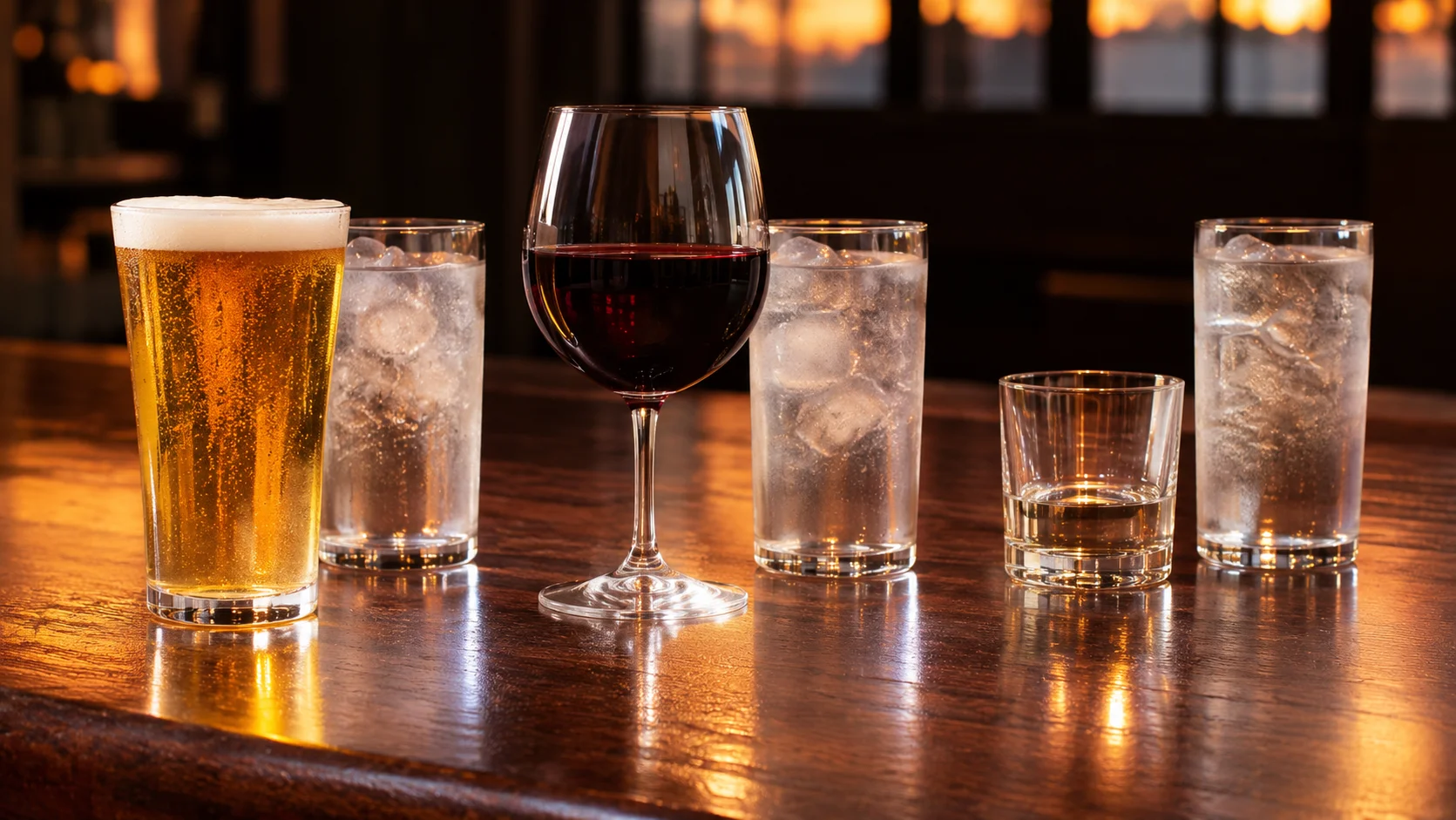
Each participant consumed an Amstel pilsner containing 5 percent alcohol, a Merlot containing 13.5 percent alcohol and Bols jenever containing 35 percent alcohol. He also consumed an alcohol-free comparison drink for each alcoholic beverage. Every alcoholic serving supplied the same 30 grams of alcohol, slightly more than two U.S. standard drinks, but the serving sizes varied substantially: about 750 milliliters of beer, 279 milliliters of wine and 108 milliliters of spirits.
The drinks were served in three portions with lunch, alongside a controlled daily fluid intake of 2.5 liters. The comparison for the spirits was 108 milliliters of tap water, allowing the researchers to separate the effect of alcohol from the effect of drinking a larger volume. Urine was collected hourly for four hours and then measured over the full 24-hour period.
Beer and alcohol-free beer produced almost identical results. After four hours, participants had passed an average of 829 milliliters after drinking regular beer and 836 milliliters after drinking alcohol-free beer. The 24-hour totals were also similar.
Wine and spirits produced a different short-term pattern. Urine output was higher than after their alcohol-free comparisons at two, three and four hours, but the difference had disappeared by the end of the day. The researchers concluded in Nutrients that moderate amounts of stronger alcoholic drinks caused a “short and small diuretic effect” in older men. Their conclusion about beer was more specific: a moderate amount of a low-alcohol drink such as beer did not compromise hydration in the study group.
Why Beer Produced Little Net Fluid Loss
The volume of the drink helps explain the result. A 750-milliliter serving of beer is mostly water, so the fluid consumed with the beer can offset the additional urine prompted by its alcohol content. Spirits deliver the same amount of alcohol in a much smaller volume. A shot or a small cocktail therefore supplies far less water alongside the alcohol.
This distinction is important when comparing drinks by alcohol content rather than by glass size. A pint of beer and a shot of spirits can contain a similar amount of alcohol, but the beer also provides substantially more fluid. The Dutch study controlled for that difference by pairing the spirits with an equally small serving of water.
The broader pattern resembles the findings discussed in our breakdown of whether coffee counts toward hydration: a beverage can have a mild diuretic effect without causing meaningful net dehydration when consumed in moderate amounts as part of a normal fluid intake. The dose and the overall balance of fluid matter more than the reputation of the drink.
Dehydration After Exercise Changes the Response
The question becomes more practical after exercise, when sweating has already reduced the body's fluid stores. Two studies examined beer during that recovery period and found that starting hydration status influenced the result.
In a 2010 study published in Alcohol and Alcoholism, Hobson and Maughan had 12 men complete intermittent cycling in hot conditions. The participants then drank one liter of beer on four occasions: twice as alcohol-free beer and twice as beer containing 4 percent alcohol. On some occasions they were rehydrated before drinking; on others they remained dehydrated.
When the men remained dehydrated, urine output after alcoholic beer averaged 261 milliliters, compared with 174 milliliters after alcohol-free beer. The difference was not statistically significant. Once participants had been rehydrated, however, the difference became clear. The authors concluded that alcohol's diuretic action may be blunted when the body is already short of fluid.
A 2016 study led by A.H.C. Wijnen examined beer as a recovery drink after mild exercise-induced dehydration. Researchers compared alcohol-free beer, beer containing 2 percent alcohol, full-strength 5 percent beer, water and an isotonic sports drink.
Full-strength beer produced more urine early in recovery than the sports drink—299 milliliters compared with 105 milliliters—but total urine output over the five-hour observation period did not differ significantly among the drinks. The researchers described the result cautiously in Frontiers in Nutrition, writing that full-strength beer “had the tendency to increase urine output.”
These findings do not establish beer as an effective recovery beverage. They show that the short-term urine response is more complicated than the claim that every alcoholic drink automatically causes major dehydration.
What the Studies Did Not Measure
The evidence has important limits. The 2017 and 2010 studies included only men, while the 2017 participants were all between 60 and 75. Applying the results to women, younger adults or people with medical conditions requires caution rather than assumption.
The sample sizes were also small: 20 men in the 2017 crossover study and 12 in the 2010 exercise study. Crossover designs improve comparisons because each participant serves as his own control, but the results still describe average responses in narrowly defined groups.
The study conditions were more controlled than a typical social occasion. Participants ate prescribed meals, consumed set volumes and followed a fixed drinking schedule. Food can slow alcohol absorption, while drinking the same amount quickly can produce a higher blood alcohol concentration and a stronger immediate effect. The 2017 study served the drinks in three portions during lunch, a pattern that does not reflect rapid drinking at a party or bar.
Nor did these trials assess every outcome relevant to recovery. They did not determine how the drinks affected sleep quality, muscle repair, reaction time, next-day performance or the ability to complete a subsequent training session. Similar 24-hour urine totals do not mean that alcohol and water are equally useful for health or athletic recovery.
Practical Guidance for Hydration and Alcohol
The research supports a limited conclusion: moderate beer consumption may not cause meaningful net dehydration in a well-hydrated adult, while wine and spirits can produce a small, temporary increase in urine output. The evidence does not support using alcohol to rehydrate, and it says little about larger quantities.
- Replace fluid and electrolytes first. After a long run, game or workout in the heat, drink water and consider a sodium-containing beverage or a meal with salt. This is more reliable than depending on alcohol-containing drinks.
- Do not treat beer as a sports drink. Beer may contain water and small amounts of carbohydrates, but alcohol can interfere with sleep and recovery, even if total urine output later returns to normal.
- Choose alcohol-free beer if hydration is the priority. In the cited trials, alcohol-free beer tracked the plain-fluid comparisons more closely than full-strength beer and preserves the social ritual without the alcohol dose.
- Alternate alcoholic drinks with water. A full glass of water between drinks helps restore the volume that beer provides naturally and slows the overall pace of consumption.
- Pay attention to the number of drinks. The trials examined roughly two standard drinks or one liter of beer. Five or six drinks fall well outside the evidence and can produce substantially different effects.
For people finishing exercise, the practical order remains the same as in our coverage of food versus sports drinks after exercise: rehydrate first, eat a balanced meal, and treat alcohol as optional rather than as a replacement for either. Spirits require particular caution because a cocktail or shot can deliver the alcohol in a pint of beer in only a few sips of liquid.
The most defensible takeaway is therefore narrow. Beer is not automatically dehydrating in the way popular advice often suggests, but neither is it a recovery drink. Starting hydration, alcohol concentration, serving size and total intake determine the outcome, and once drinking becomes heavy, these small controlled studies no longer provide reassurance.