In a lab at the Université de Montréal, researchers ran tap water from the town of Saint-Donat through five popular pitcher filters until each had processed 160 liters. The water carried 56 nanograms per liter of PFAS. The ZeroWater and ClearlyFiltered pitchers removed 99 percent of the so-called forever chemicals on a volume-weighted basis. Aquagear removed 77 percent and the Brita Elite removed 20 percent, according to the 2024 study in Frontiers in Environmental Chemistry.
The team tested the filters against 75 different PFAS compounds. Their conclusion pointed at the label rather than the brand: "The two NSF or WQA certified filters with advanced and multi-stage filtration systems, named ZeroWater and ClearlyFiltered filters, demonstrated the highest PFAS removal performances."
That is the short version of this buyer's guide. A home water filter should be bought by the independent certification it carries and the specific contaminants that certification covers. For people who drink more water once they trust what comes out of the tap, the choice also shapes a daily hydration habit.
What the Certification Numbers on the Box Mean
Filter standards carry the joint NSF/ANSI name, and each number covers a different job. According to NSF's consumer guide, NSF/ANSI 42 covers aesthetic impurities such as chlorine, taste and odor. NSF/ANSI 53 covers contaminants with a health effect, NSF/ANSI 58 covers reverse osmosis systems, and NSF/ANSI 401 covers emerging contaminants such as pharmaceuticals and chemicals that are not yet regulated. Shower filters fall under NSF/ANSI 177, which addresses free chlorine only.
The Environmental Protection Agency tells shoppers who want PFAS reduction to look for certification to NSF/ANSI 53 or NSF/ANSI 58. Five ANSI-accredited bodies can grant it: CSA Group, IAPMO R&T, NSF, UL and WQA. A pitcher certified only to Standard 42 may improve the taste of your water and do little about the contaminants that sent you shopping in the first place.
NSF's PFAS claims have tightened over time. The organization added PFOA and PFOS claims to Standards 53 and 58 in 2017. In 2022 it added a total PFAS claim and lowered the combined limit from 70 to 20 parts per trillion, according to its history of the standard. Task groups are now working to align those standards with the federal drinking water rule.
Pitchers, Under-Sink Systems and Reverse Osmosis: What the Tests Found
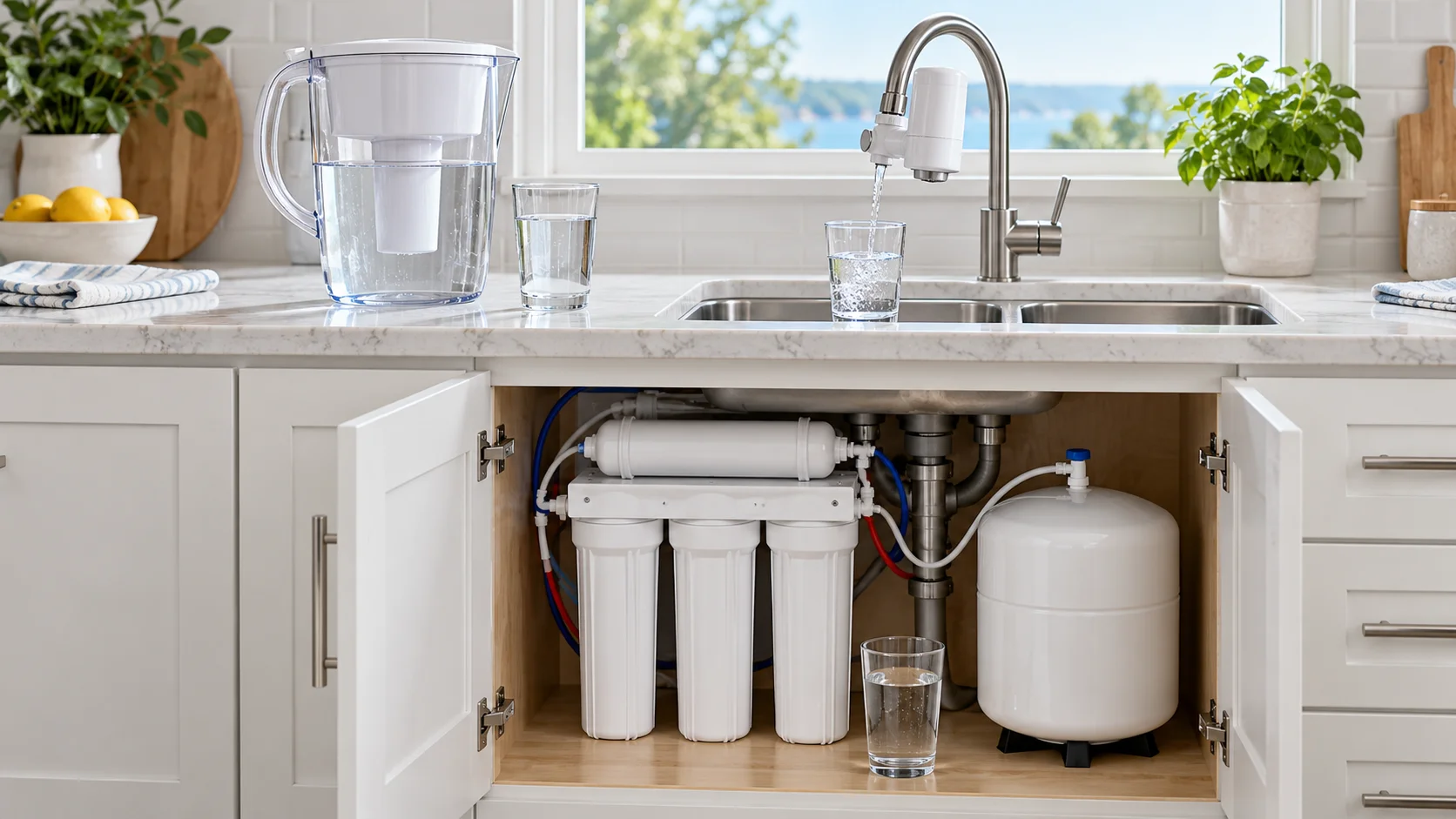
The broadest comparison comes from Duke University and North Carolina State University, whose team tested 76 point-of-use filters and 13 whole-house systems and published the results in 2020. Reverse osmosis filters and two-stage filters cut PFAS, including GenX, by 94 percent or more, while activated-carbon filters averaged 73 percent removal with wide variation, according to the Duke release on the study.
Under-sink reverse osmosis and two-stage filters
"All of the under-sink reverse osmosis and two-stage filters achieved near-complete removal of the PFAS chemicals we were testing for," said Heather Stapleton, then an associate professor of environmental health at Duke's Nicholas School of the Environment. Detlef Knappe, a distinguished professor of civil, construction and environmental engineering at NC State, singled out one format. "The under-sink reverse osmosis filter is the most efficient system for removing both the PFAS contaminants prevalent in central N.C. and the PFEAs, including GenX, found in Wilmington." The Duke team also noted that reverse osmosis systems cost significantly more than the alternatives.
Pitchers, faucet mounts and refrigerator filters
Stapleton's assessment of the cheaper formats was blunt. "In contrast, the effectiveness of activated-carbon filters used in many pitcher, countertop, refrigerator and faucet-mounted styles was inconsistent and unpredictable," she said. The Montreal results show that spread within a single category. On Montreal's own tap water, which carried a lighter 13 nanograms per liter, removal ranged from about 100 percent for ZeroWater down to 38 percent for the standard Brita pitcher. Longer-chain PFAS were removed more effectively than short-chain compounds across the board.
Whole-house systems
Whole-house filters produced the most surprising result in the Duke data. In four of the six whole-house systems the team tested, PFAS levels rose after filtration, and Stapleton described the category as "widely variable." A point-of-use filter at the kitchen tap, where the drinking water comes out, is the more reliable target.
Lead: The Line to Find on the Package
Lead calls for its own check. The EPA advises looking for certification against NSF/ANSI 53 with a lead-reduction claim, plus NSF/ANSI 42 for Class I particulate reduction. Its 2024 shopper's guide spells out the wording to find on the box: "Tested and Certified by (certification body) against NSF/ANSI Standards 42 and 53 for the claims specified on the Performance Data Sheet." The performance data sheet is where the contaminant-by-contaminant claims live, and it is worth reading before checkout.
Certifications lapse, so NSF recommends confirming a product on the certifying body's own website to make sure the listing is current.
Microplastics and Standard 401
For shoppers worried about plastic particles, NSF's guidance is direct: filters certified to NSF/ANSI 401 help reduce microplastics and other emerging contaminants, according to its water filter FAQ. We covered how reverse osmosis and distillation handle plastic particles in our look at microplastics and your inner frontier. The tradeoffs of the water that comes out the other side are in our comparison of alkaline and distilled water.
The Rules Behind the Filter Aisle
Federal policy is still in motion. The EPA's drinking water rule set limits of 4.0 parts per trillion each for PFOA and PFOS, with an original compliance date in April 2029. On May 18, 2026, the agency proposed extending that deadline to April 2031. On the same day it proposed rescinding the limits for PFHxS, PFNA, GenX and a hazard index mixture that includes PFBS, with public comments closing July 20, 2026.
The EPA's own filter page carries a caveat worth knowing. As of April 2024, current certifications "do not yet indicate that a filter will remove PFAS down to the levels EPA has now set for a drinking water standard." Knappe put the limit plainly in 2020: "Home filters are really only a stopgap. The real goal should be control of PFAS contaminants at their source."
Maintenance Decides Whether Any of This Works
"Filters are only effective if they are maintained according to the manufacturer's instructions," the EPA states, and the lab data show why. In the Montreal tests, ZeroWater's performance fell off at around 80 liters, and the researchers noted that increasingly acidic filtered water is a sign the cartridge is exhausted. The Duke team likewise advised changing activated-carbon filters on a regular schedule.
A calendar reminder tied to the cartridge's rated capacity costs nothing. A household that drinks two liters a day each for two people will run through 80 liters in about three weeks.
The Hydration Payoff
A filter's value shows up in the glass as well as the lab. A CDC-authored analysis of 4,042 adults, published in 2022 in the American Journal of Health Promotion, found that 36 percent used a water filter and 14 percent did not drink tap water at home. Filter users had higher odds of drinking more than three cups of tap water a day and lower odds of drinking sugar-sweetened beverages daily.
The picture is not uniform. A 2023 study of 793 university students in Public Health Nutrition found that students who distrusted their tap water were less likely to drink three or more cups of water a day. They were also more likely to drink sugary drinks daily. Students who filtered their tap water were also less likely to reach three cups.
Americans drank an average of 1,066 milliliters of water a day between 2011 and 2016, with 62 percent of it from the tap, according to a Nutrition Journal analysis of national survey data. A certified filter, a replacement cartridge on the calendar and a full pitcher in the refrigerator are one practical way to push that daily number higher.