
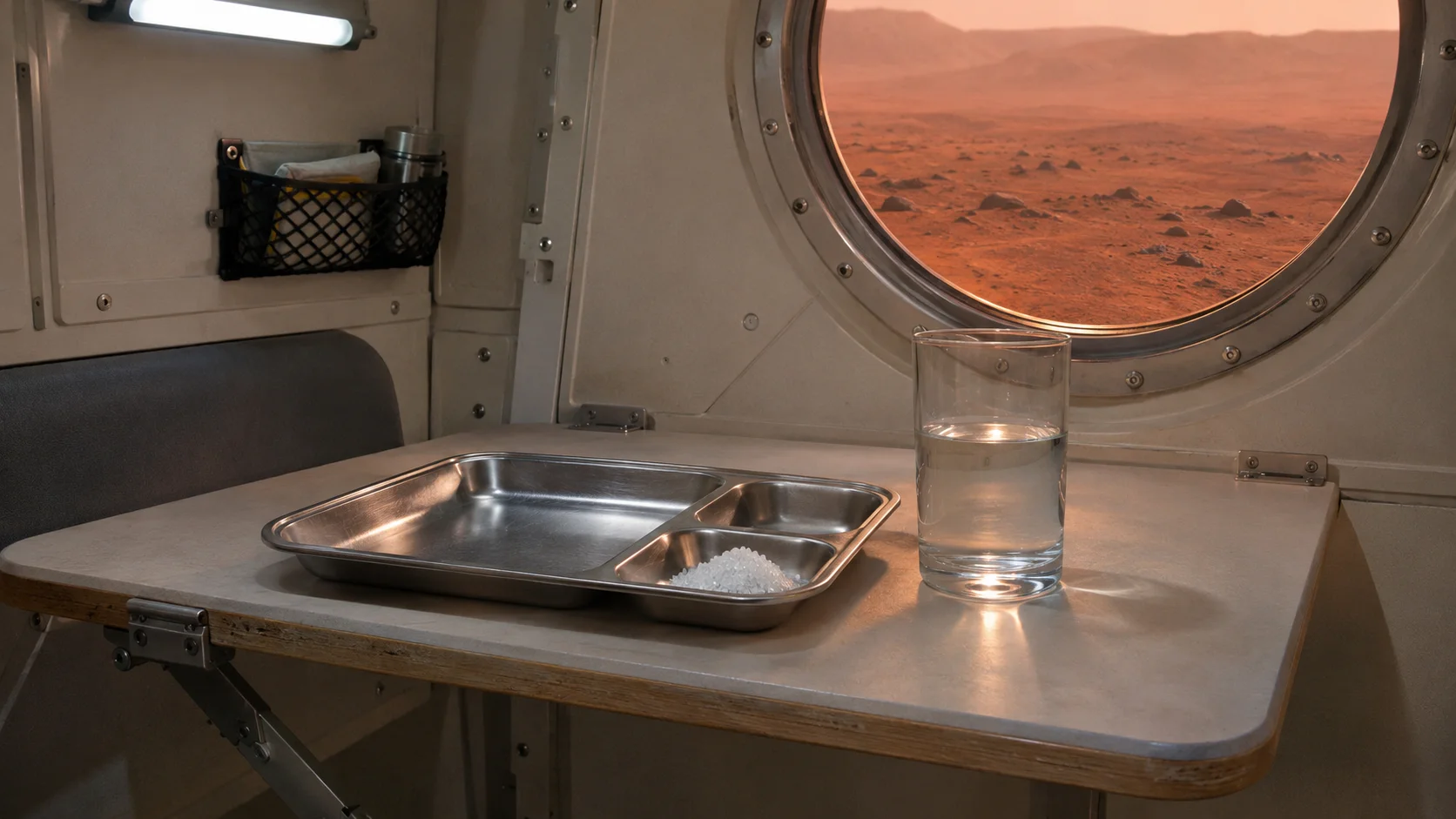
For 105 days and then for 205 more, a small group of men lived inside a sealed space flight simulator where every gram of salt they ate was weighed in advance. Researchers collected every drop of urine for months, which made it the cleanest test anyone had run of a belief most people never question, that salty food makes you drink more water.
The men on the saltiest diet drank less. The study, led by Natalia Rakova and Jens Titze and published in the Journal of Clinical Investigation in 2017, opens by naming the assumption it set out to test: "The idea that increasing salt intake increases drinking and urine volume is widely accepted."
Over weeks and months, salt and hydration work differently than the potato-chip experience suggests. The body responds to a sustained rise in dietary salt by holding on to water through the kidneys, so fluid intake can fall even as salt intake climbs.
The data came from two simulated missions to Mars, a 105-day study and a 520-day study, run under conditions that no outpatient trial can match. Twelve healthy young men volunteered, and two were excluded for not complying with the protocol, leaving 10 men whose diets and fluids were tracked day after day.
Each man moved through three salt levels, 12, 9 and 6 grams a day, while the team held every other nutrient constant. In the 205-day block of the Mars520 study, the crew was put back on the 12-gram regime, which let the researchers watch the same bodies respond to the same salt load twice.
For scale, 12 grams of salt carries roughly 4.7 grams of sodium, about double the 2,300-milligram daily sodium limit in the U.S. Dietary Guidelines. The 6-gram level lands close to that limit, so the experiment compared a typical heavy-salt Western diet with a recommended one.
The headline number sits in the paper's results. Water intake was 293 milliliters a day higher, give or take 27, when the men ate 6 grams of salt than when they ate 12, a gap of a little more than a standard 250-milliliter glass of water every day, running in the opposite direction from the textbook expectation.
Urine did not behave as predicted either. The authors found that adding 6 grams of salt a day left urine volume essentially unchanged, even though the kidneys were clearing more sodium, because the extra salt cut the amount of free water the kidneys let go. The kidneys were concentrating urine and keeping water the body had made or already held.
Most people picture salt pulling water out through the urine, which would leave the body short and force more drinking. In these men, the kidneys did the opposite, retaining free water while the extra sodium left, so the body ran a small water surplus on its own, and the published paper ties that surplus directly to the drop in drinking at the 12-gram level. The men were not thirstier because their bodies were already keeping more water than before.
The team also tracked urinary hormones and found that water balance followed weekly and half-weekly rhythms of aldosterone and cortisol release. Higher salt dampened the mineralocorticoid rhythm and raised the glucocorticoid rhythm, and the model built from those shifts matched the measured drop in drinking.
That rhythm explains why a single day of measurements can mislead. Fluid balance in these men swung on a cycle of several days, which a weekend study or a one-meal test would never capture.
A companion study in mice, published in the same issue, pointed to the mechanism. Urea, the nitrogen compound most people know as a waste product, built up in the kidney and offset the water-drawing pull of sodium and chloride, which let water move back into the body while salt left in the urine.
Friedrich Luft of the Charité and the Max Delbrück Center described the shift in the center's announcement of the findings: "It's not solely a waste product, as has been assumed." He went on to call urea an important osmolyte, a compound that binds water and helps move it.
Titze described the system as bigger than the kidney alone. "We now have to see this process as a concerted activity of the liver, muscle and kidney," he said.
Making urea costs energy, and the mouse work showed where that cost landed. Mice on high-salt diets were not thirstier, but they ate more, and the researchers linked the extra food to liver ketone production and the breakdown of muscle protein that salt-driven glucocorticoids set in motion.
The human crew showed a parallel. According to the Max Delbrück Center, the men on the saltier diet complained about being hungry, even though their calories had been set to meet the needs of a moderately active day, which places salt in the energy-balance picture alongside water, with appetite rising while drinking falls.
The study has limits worth keeping in view. The participants were 10 healthy men living in a sealed module on calories set for a moderately active day, not athletes training in heat, and people who lose a liter or more of sweat in an hour face a different problem that this study did not test.
The findings also describe adaptation over weeks. The familiar thirst after a salty restaurant meal is a short-term osmotic response that the research does not dispute, and the Rakova paper never set out to measure it.
Sustained high salt intake also has well-documented costs for blood pressure, and the paper offers no argument for eating more of it. Its contribution is a better map of how the body handles the salt it gets.
For anyone tracking edible hydration, the practical lesson is that the sodium in food shapes how much of the water you drink stays in your body. That is the same principle behind the post-workout meal research we covered in October, where volunteers who ate a salty meal with their water retained more fluid than those who drank a sports drink alone.
It also changes how to read a thirst cue. before, and that shift reflects a body that is conserving less, not a hydration problem, while a person on a salty diet who rarely feels thirsty is not necessarily well hydrated.
The most useful habit is to treat salt as one input to fluid balance, alongside sweat, food water and the drinks themselves. Labels on electrolyte mixes vary widely in sodium per serving, as our comparison of drink mix labels showed, and the salt in a day's meals belongs in the same tally.
Salt is also easy to undercount, because most of it arrives inside bread, sauces, cheese and restaurant food rather than from the shaker. Anyone trying to match drinking to need will get closer by reading sodium on food labels for a week than by guessing from how thirsty a meal felt.
The Mars crews spent months showing that thirst is a negotiation among the kidneys, the liver and the muscles. The next round of research will need people who sweat, train and eat freely to show how that negotiation runs outside a sealed module.