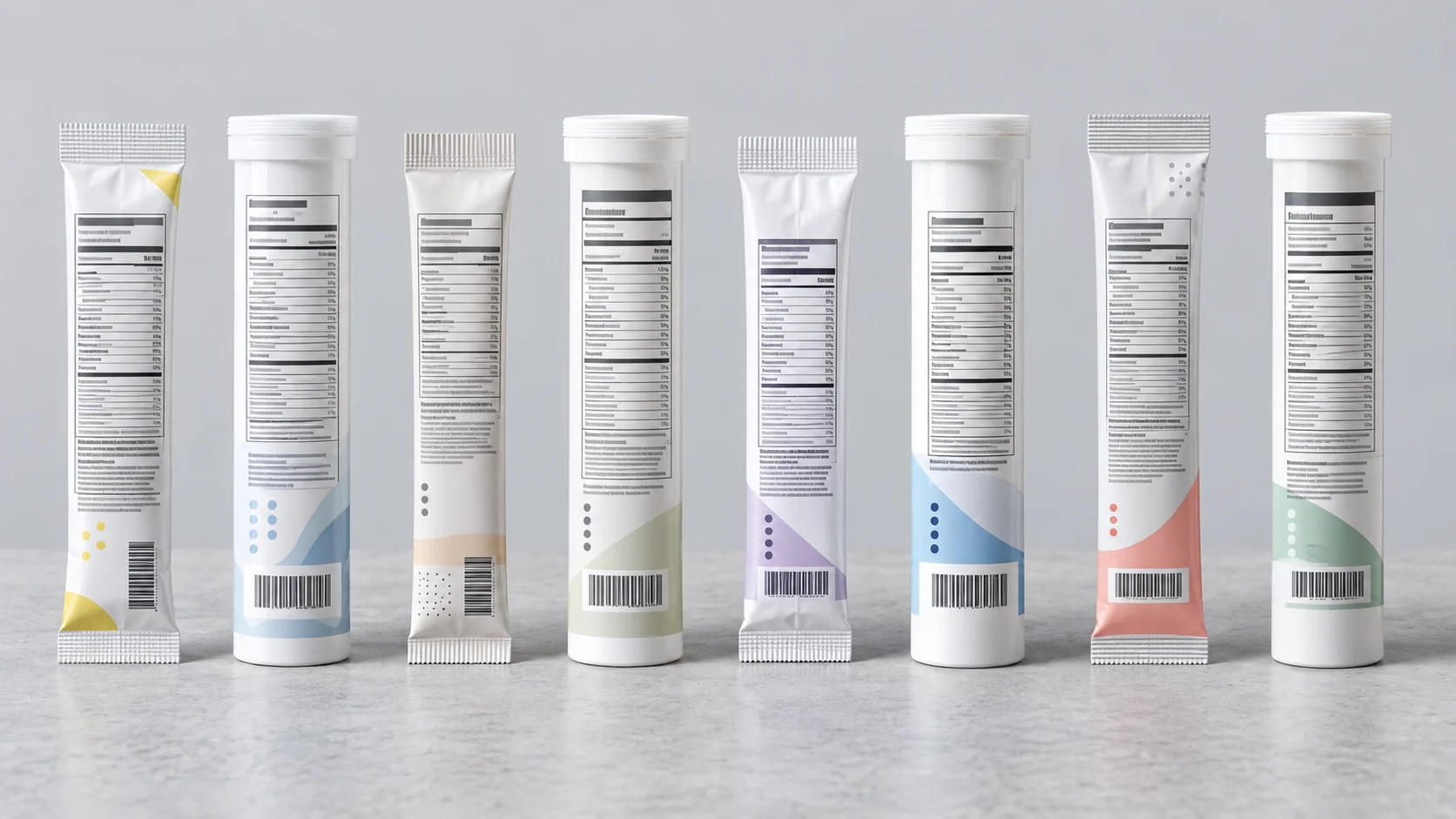
Two sticks of powder sit on the same shelf, both photographed against the same clean white background, both printed with the word electrolytes. One delivers 55 milligrams of sodium. The other delivers 1,000. Nothing on either front panel tells you which one belongs in your bottle, and the difference between them is not a rounding error but an eighteenfold spread inside a single product category.
The number that decides which electrolyte drink mix is right for you is not printed on any of them, because it lives in your sweat. Gatorade's own athlete-facing science resource puts the human range at 230 to 2,070 milligrams of sodium per liter, a ninefold spread between two people doing the same workout in the same room. That single range is why there is no best electrolyte mix, and why reading the back of the packet is a skill worth twenty minutes.
The four numbers that matter, in order
Sodium per serving comes first because it is the electrolyte you actually lose in quantity and the one that governs whether the fluid you drink stays in you. Lindsay Baker of the Gatorade Sports Science Institute, writing in Sports Science Exchange 244, notes that "the presence of sodium in a beverage can promote fluid intake (thirst and drink palatability)" before it does anything else, which is the unglamorous mechanism behind most of the category. It is worth saying plainly that GSSI is funded by Gatorade's parent company, and worth saying just as plainly that its published science holds up independently of that.
The American College of Sports Medicine's position stand on exercise and fluid replacement recommends sodium at 0.5 to 0.7 grams per liter of water for exercise lasting longer than an hour, which is 500 to 700 milligrams per liter. Measure the shelf against that band and the category sorts itself into three groups rather than a ranking.
Where the products actually land
LMNT publishes 1,000 milligrams of sodium, 200 of potassium and 60 of magnesium in a single stick pack, which lands well above the ACSM band unless you are mixing it into considerably more than a liter. Precision Fuel and Hydration builds PH 1500 at 1,500 milligrams of sodium per liter and says so in the product name, putting roughly 750 milligrams into a 16 ounce bottle. These are replacement-first formulas, designed for the salty end of that 230 to 2,070 range and for the sessions where sweat loss is measured in liters.
The middle group sits close to the guidance. Liquid I.V.'s Hydration Multiplier declares 500 milligrams of sodium and 370 of potassium per 16 gram stick, mixed into 16 ounces of water. Nuun Sport tablets carry 300 milligrams of sodium, 150 of potassium and 25 of magnesium per tablet in the same volume. Skratch Labs lists 400 milligrams of sodium per scoop, with its apple cider flavor at 370. Gatorade's Endurance Formula carries 310 milligrams of sodium and 140 of potassium per 12 ounces, while the standard Thirst Quencher is described by Gatorade as containing about 270 milligrams of sodium in a 20 ounce serving.
Then there is Ultima Replenisher, which declares 55 milligrams of sodium alongside 250 of potassium, 100 of magnesium and zero carbohydrate. That is not a defective product, it is a different product, built for people who want minerals and flavor without sugar or salt load, and it is the reason the word electrolytes on a front panel tells you almost nothing.
Carbohydrate is a second decision, not a bonus
The sugar content of these mixes gets criticized in isolation, which misreads what the carbohydrate is doing. Baker's review reports that a small amount of carbohydrate, on the order of 1 to 3 percent, improves the rate of fluid delivery compared with carbohydrate-free solutions, and that beverages at or above 8 percent carbohydrate slow gastric emptying and raise the odds of gut discomfort. The ACSM stand brackets the same question from the other side, reporting that most people empty more than a liter an hour when fluids sit in the 4 to 8 percent range.
Run the products through that lens and the picture inverts. Liquid I.V.'s 11 grams of carbohydrate, all of it added sugar in a 45 calorie stick, works out to roughly 2.3 percent when mixed into 16 ounces, which sits inside the band shown to help absorption rather than hinder it. Nuun Sport's 4 grams per 16 ounces lands near 0.8 percent, below the range that aids fluid delivery, which is a fair trade if what you want is salt without calories. Gatorade Thirst Quencher carries 21 grams of carbohydrate and 80 calories per 12 ounces, and the Endurance Formula 22 grams and 90 calories, which is fuel-first design and should be judged as fuel.
Pedialyte is the clearest illustration of design intent in the whole category, pairing 390 milligrams of sodium with only 7 grams of carbohydrate and 25 calories per 12 ounces. That ratio is oral rehydration solution architecture, built to move water and salt across the gut wall rather than to feed a working muscle, which is why it behaves differently in a bottle and why parents and ultrarunners both reach for it.
The evidence that a sports drink is not automatically more hydrating
Ronald Maughan and colleagues tested thirteen beverages across three laboratories in 72 euhydrated men, each drinking a liter over thirty minutes, then collected urine for four hours to build what they called the beverage hydration index. Oral rehydration solution scored 1.54 at two hours, full-fat milk 1.50 and skimmed milk 1.58, all meaningfully better than still water. Cola, tea, coffee, beer, orange juice and sports drink produced urine volumes that were not different from water at all.
That finding does not make sports drinks useless, because retention at rest in a hydrated person is a different question from fluid delivery during a hot two-hour session. It does mean the phrase more hydrating, printed on a shelf tag, has no support behind it for a conventional sports drink, and that a glass of milk after training is doing more for fluid balance than the marketing of either product suggests.
How to buy for your own sweat
Start with duration, because the ACSM stand is blunt about the short end, reporting that during exercise lasting less than an hour "there is little evidence of physiological or physical performance differences between consuming a carbohydrate-electrolyte drink and plain water." For a forty minute gym session the honest recommendation is water, and the stick pack is a flavor preference rather than a performance intervention. The threshold where electrolytes start to earn their place is longer than most buyers assume.
Then estimate your own loss rather than borrowing someone else's. Gatorade's sweat data puts whole-body sweating rates at roughly 1.51 liters per hour for endurance athletes, 1.28 for football, 0.95 for basketball and 0.83 for baseball, so an endurance athlete at the salty end of the concentration range can shed well over 2,000 milligrams of sodium in ninety minutes while a recreational lifter in an air-conditioned gym sheds a small fraction of that. The same stick serves those two people very differently, and building the plan around your own sweat is the step that makes the label numbers useful.
Finally, check the serving basis before you compare anything, because the category is inconsistent about it. Pedialyte publishes per 12 ounces and per liter, Gatorade quotes sodium per 20 ounces while listing carbohydrate per 12, Precision Fuel and Hydration states sodium per liter for a 500 milliliter sachet, and Skratch's own page presents a per-scoop panel of 400 milligrams alongside an electrolyte profile of 400 milligrams per liter, two figures that cannot both describe one scoop in 12 to 16 ounces. Several brands publish their panels only as images, so the numbers exist but resist comparison.
The useful habit is arithmetic rather than brand loyalty. Convert every product to milligrams of sodium per liter of finished drink, set that against the 500 to 700 band for sessions over an hour, adjust upward if you finish workouts with salt crust on your face and downward if you never do, and treat the flavor as what it is, the reason you will actually drink the bottle. An 18 to 1 sodium spread across one shelf is not a scandal. It is a category serving very different bodies, printed in numbers that most buyers have never been taught to read.