In a heat chamber at Iowa State University in the 1990s, graduate student Melinda Ray watched volunteers sweat off about two and a half percent of their body weight. She then gave each one plain water, a sports drink, chicken broth or chicken noodle soup, and two hours later the soup and broth groups had restored more blood plasma than the water group.
That result has sat inside a doctoral dissertation for almost three decades, and its best use may come in the months when almost nobody thinks about fluid intake at all. Winter mutes thirst and pulls water out with every breath of dry air, which turns winter hydration from food into a practical strategy for runners, ski crews and anyone who commutes on foot.
University of New Hampshire researchers found that cold weather can blunt thirst by as much as 40 percent, and the Iowa State trials showed salted liquid foods holding fluid better than plain water. Read side by side, the two bodies of work point toward a bowl of soup as a way to replace water that people in the cold will not feel themselves losing.
Robert Kenefick, then an associate professor of kinesiology at New Hampshire, studied fluid loss during work and exercise in low temperatures, publishing in Medicine and Science in Sports and Exercise. He traced the problem to the way the body guards its core temperature once skin meets cold air.
When the surface of the body chills, blood vessels near the skin constrict to hold heat inside, and that shift pushes blood toward the center of the torso. Sensing plenty of volume in the core, the brain misses the drop in total body water, so the hormone that tells the kidneys to conserve fluid slows even as blood sodium climbs.
"People just don't feel as thirsty when the weather is cold," Kenefick said in a university release that described the work. The release also noted fluid deficits of 3 to 8 percent of body mass among people working in the cold, a range that overlaps losses that degrade strength and endurance in warm-weather studies.
Summer sweat announces itself on a shirt or a forehead, but winter losses leave through quieter exits that most people never notice. Cold, dry air gets warmed and humidified inside the lungs with every breath, while sweat under insulated layers evaporates almost as soon as it reaches the skin.
Kenefick pointed to both routes, along with the extra effort of moving under bulky clothing, as reasons cold-weather dehydration catches people off guard. For a runner logging dawn miles in Albany or a crew framing a house in December, water drains away steadily while the usual reminder to drink never comes.
Waiting for thirst works well enough at a desk in October, but it grows far less reliable once the wind chill drops and the signal stops arriving on schedule.
Ray completed her dissertation in 1997 under advisors Richard Engen, Douglas King and Rick Sharp, and it ran two separate experiments. In the first, 18 people exercised in heat until they lost 2.6 percent of body weight, then spent three hours rehydrating with water or a broth salted to one of three levels.
Volunteers who drank the medium-sodium broth recovered 73 percent of the weight they had lost, compared with 61 percent for those on the low-sodium version. Plasma volume, the watery portion of blood that carries oxygen and nutrients, returned to 105 percent of baseline on the medium broth and 104 percent on the high-sodium broth, against 97 percent on water.
Urine output told the same story in reverse, with the water group producing 351 milliliters over the recovery period and the low-sodium group producing 379. The medium and high-sodium broths cut those totals to 229 and 195 milliliters, which meant the saltier recipes kept more of each serving in circulation instead of sending it to the bladder.
The second experiment put 30 people through a similar routine, this time with a 2.5 percent weight loss and a two-hour recovery window. Chicken noodle soup restored plasma volume to 99 percent of baseline and chicken broth to 98 percent, while plain water brought volunteers back to only 94 percent.
The carbohydrate-electrolyte sports drink in that trial carried far less sodium than the broth, and it produced 310 milliliters of urine compared with 188 for the broth. Ray concluded that sodium in a rehydration fluid improves the restoration of both body weight and plasma volume, a finding laid out in full in the Iowa State dissertation.
More than a decade later, a team that again included Sharp and King presented a related study at the American College of Sports Medicine's 2009 annual meeting. Twenty men were dehydrated by about 3 percent of body mass, then rehydrated with chicken noodle soup or a flavored placebo drink that looked similar but lacked the soup's sodium and carbohydrate.
Body weight recovery did not differ between the two groups, yet time-trial performance afterward was significantly better after the soup. Because the result appeared as a conference abstract rather than a full paper, it supports the direction of the earlier Iowa State work without settling how large the effect is.
The physiology here will be familiar to anyone who has followed our coverage of pickle juice and muscle cramps, where salt plays a different role than most athletes assume. Sodium raises the concentration of the fluid surrounding cells, which reduces the kidneys' urge to dump water, so a salted liquid tends to stay in circulation longer than the same volume of plain water.
Soup brings two further advantages in the cold, starting with the fact that people crave a hot bowl on a raw afternoon. That craving sidesteps the weakened thirst signal by tying fluid intake to appetite and warmth rather than to a cue the body has stopped sending.
It also arrives as part of a meal, and food in the stomach slows the rate at which fluid empties into the intestine, spreading absorption across a longer window. Our earlier look at post-workout meals and fluid retention walks through that effect in more detail for athletes recovering after training.
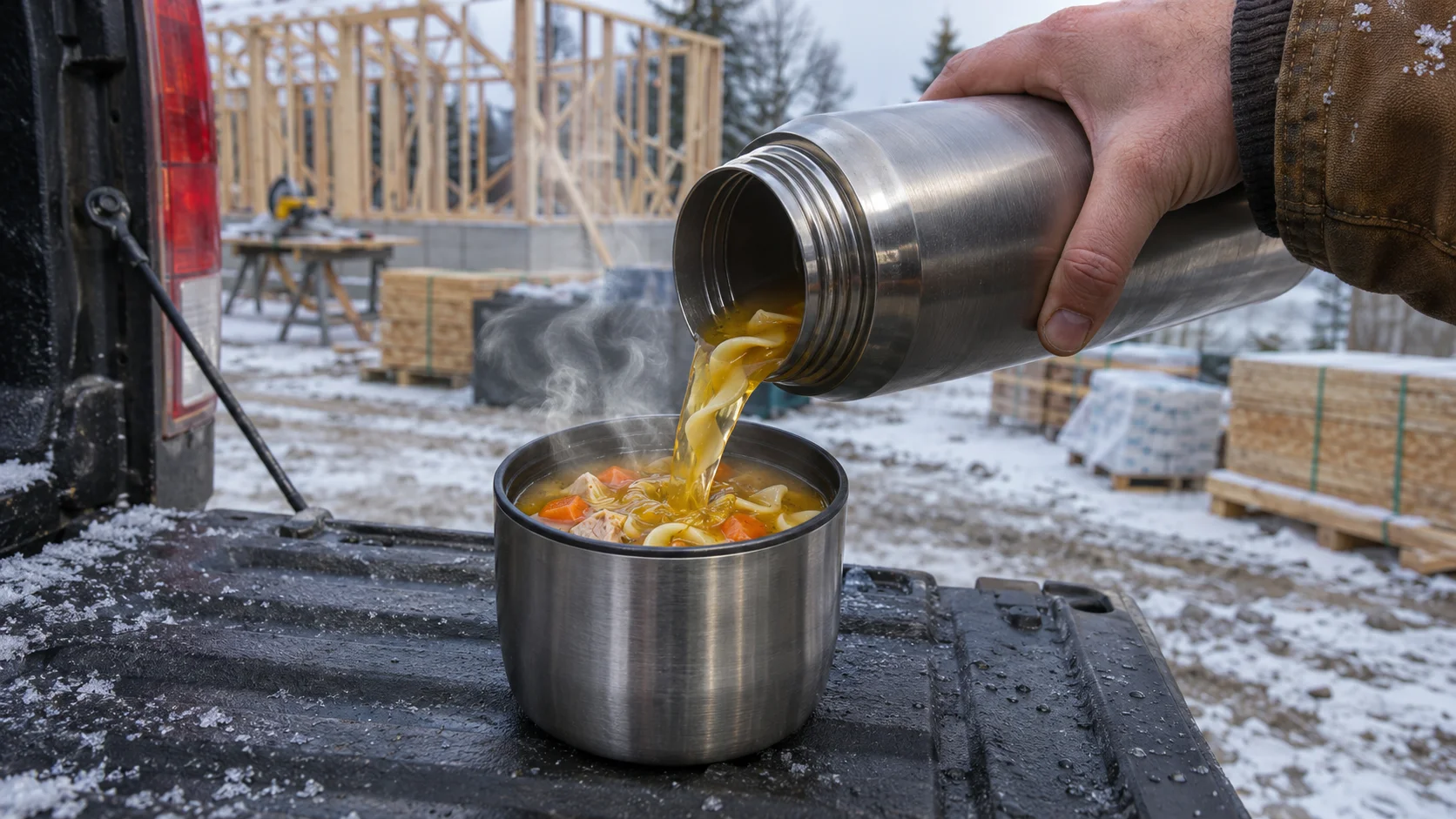
Broth after a cold-weather run, a thermos on a winter job site or a mug of stock beside lunch on a ski day all follow the Iowa State protocols. Volume still counts, since those trials gave participants enough fluid to replace most of what they had lost, and a single cup will not cover a long session in heavy gear.
The chicken noodle soup in Ray's second study carried more than 330 millimoles of sodium per liter, roughly three times the concentration of the medium broth that performed well in the first experiment. Commercial canned soups vary widely, and someone managing blood pressure or following a sodium limit set by a physician should treat a salty bowl as a deliberate choice rather than a free pass.
Both Iowa State experiments dehydrated people with heat and exercise rather than cold, so the findings describe how salted fluids behave during recovery and say nothing direct about how cold exposure changes that process. The volunteers were small groups of healthy adults, and nobody has yet repeated the work at scale with winter athletes or outdoor laborers.
Holiday gatherings add another wrinkle, stacking alcohol onto meals during the same weeks when thirst is already quiet, and the strength of each drink shapes how much fluid it costs. A bowl of soup before the toast will not cancel that effect, though it does change how much water the body has on hand when the first glass arrives.
Kenefick's own advice for cold weather stayed simple and visual: drink plenty of water, especially when exercising or working outdoors, and check the color of your urine, which should be nearly clear.